LETTER DRAFT
Dear [Senator / Representative] [Congress Member’s Name]:
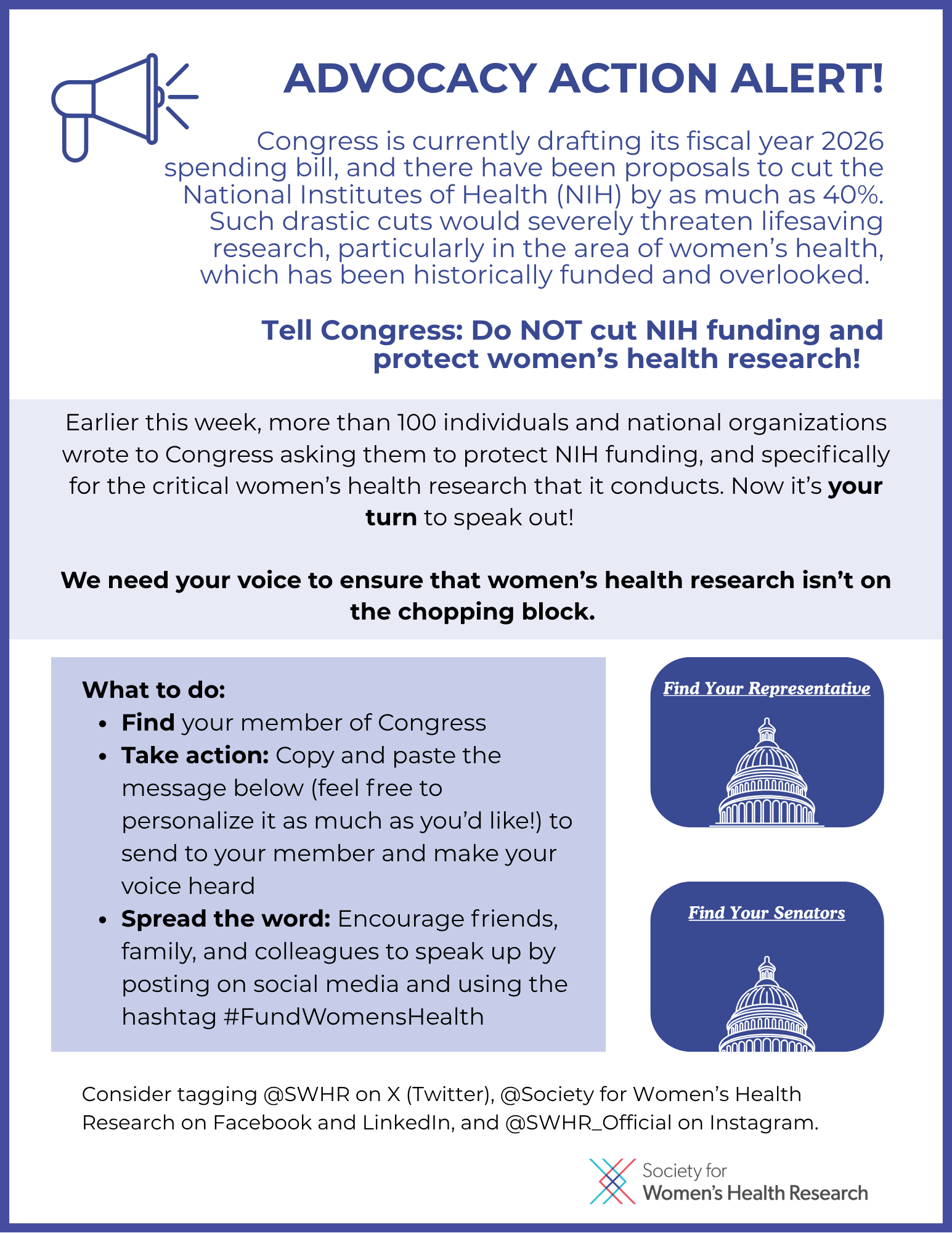
As a constituent with an interest in preserving federal investment in research into the health of women, I am writing to ensure that the National Institutes of Health’s (NIH) funding and programming are continuing to invest in women’s health research.
Sustained federal investment in biomedical research benefits all Americans. Funding for the NIH in particular has been a longstanding bipartisan priority, with members of Congress across party lines championing NIH as the crown jewel of federal investment – one of the wisest investments our nation can make for the safety, health, and well-being of our citizens.
However, I am deeply concerned about the news of significant cuts to research as well as what I am hearing about the uncertainty surrounding funding for critical studies that have advanced the health of women and understanding sex-based differences in disease. Among the many contributions that NIH has made to our understanding of health and disease, the NIH has been instrumental in advancing our understanding of how diseases affect women differently than men. Thanks to federal research investments from agencies like the NIH, we now know that women experience heart attacks differently, respond uniquely to certain medications, and face distinct health challenges throughout their lifespans. This knowledge has led to more precise treatments, improved outcomes, and saved countless lives.
A prime example of this work is the multi-site, longitudinal SWAN Study, which examines how the biological, psychological, and social changes women experience in midlife affect their overall health and long-term outcomes, providing valuable data for scientists, health care providers, women, and their families. Significant cuts to the NIH budget would mean that studies like SWAN – which represent good, efficient, and effective stewardship of taxpayer dollars – would not be able to be funded or would experience cuts at a level that would hinder their progress.
While the economic and public health benefits of investing in women’s health research is evidenced, significant gaps remain in women’s health – and this work must be prioritized. Women continue to be underrepresented in clinical trials for many conditions, and sex-based differences in disease progression and treatment response are still poorly understood across numerous medical specialties. Robust NIH funding is essential to closing these critical knowledge gaps.
As we continue in the fiscal year 2026 appropriations process, I ask that you keep federal investments in women’s health research top of mind and continue to prioritize investments in our nation’s research institutions.
Sincerely,
[Your Full Name]
[Your Address or City/State]
[Your Organization, if applicable]
[Email Address]
[Phone Number]