

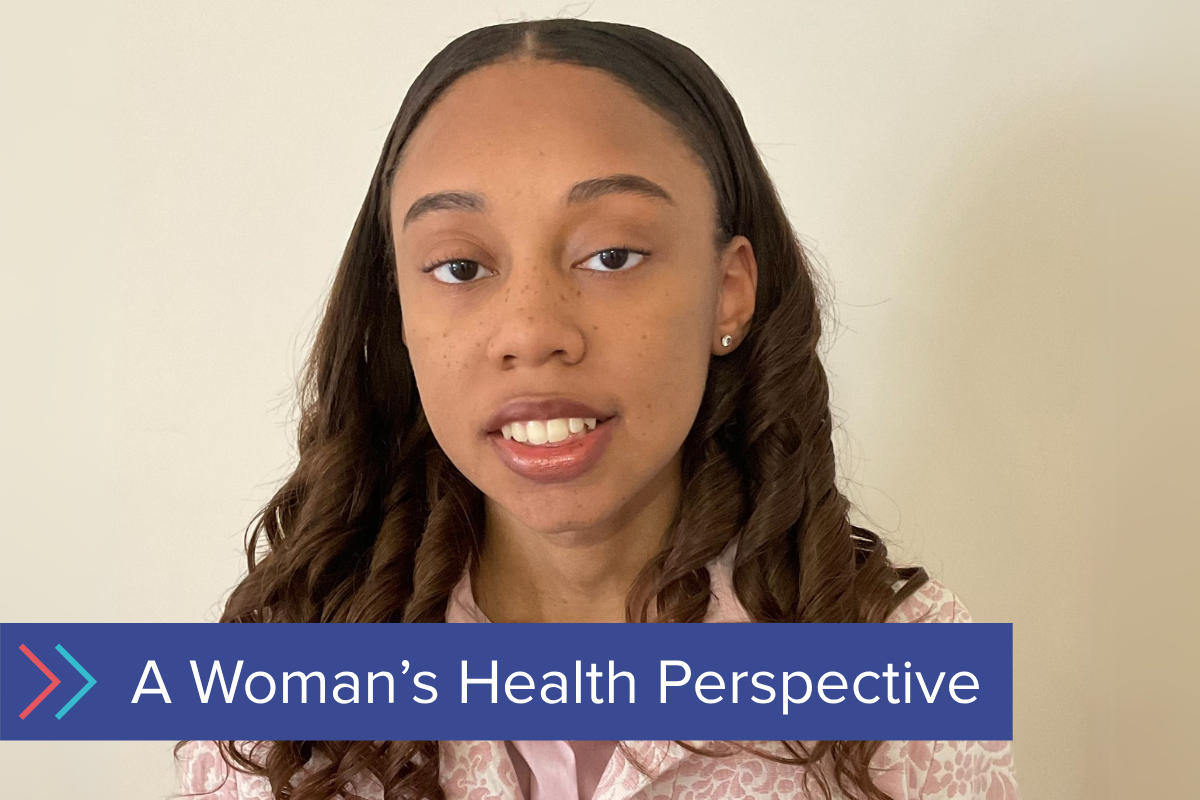
This is a firsthand account submitted through SWHR’s Share Your Story portal, as part of SWHR’s Women’s Health Perspective series.
In February 2020, it became apparent that there was something wrong with my breast. Sleeping on my side brought discomfort, and the tissue felt like it was pushing through the side of my bra. In the mirror, there was visible distention. Being an 18-year-old college freshman, I demurred for a few weeks before going to the student health center, from where I was referred to the university cancer center. At the initial ultrasound, I was told that the five-centimeter mass was believed to be a fibroadenoma – a non-cancerous breast tumor – but they wanted to do a biopsy to be sure it wasn’t a phyllodes tumor because of the size. I remember wincing as a small incision was made on the bottom of my breast and local anesthesia was pushed in. The biopsy needle made a kind of clicking sound as it removed the tissue. I was sent home with ice packs to await the results.
The biopsy results came back benign, but the physicians I saw at the hospital recommended removal because of the size and because of its apparent rapid growth. I experienced intermittent pain as I awaited treatment. As the COVID-19 pandemic response was in full swing and the removal was considered “elective,” I didn’t have the lump removed until May, shortly after my 19th birthday. I thought everything was over – but during a regular well woman visit in 2022, a second lump was discovered. I’d previously been told by a provider that women who get fibroadenomas will “just keep making them,” but I didn’t understand why.
Over the years, I’ve learned quite a lot about fibroadenomas and benign breast disease (BBD) through my experience. A lot of the advice given for breast cancer can be applicable to benign breast disease – know what your “normal” feels like and seek treatment if something feels amiss. A “wait-and-see” approach is often taken with BBD, so if you’re experiencing pain or discomfort, you should ask what your options are. Many benign conditions are predicted by family history, as it was in my case. While reading scientific papers for class, I learned about a growing body of research on the genetic makeup of benign and malignant breast tumors. However, there still isn’t a lot of research on what makes these conditions start or come back in some people. This has made me interested in advocating for more research on benign breast disease, benign tumors in other sites, and breast cancer. Additionally, ultrasounds can be pricey, which is why some advocates are now pushing for payers to cover cost-sharing for diagnostic breast imaging.
My perspective on my own health story has changed over the years, too. In the first five or six months after my initial surgery, I felt deep anxiety and reluctance to talk about the experience. Eventually, I began sharing my story as a way to process it and move on. However, after my second surgery in 2022, I felt a greater sense of urgency to act. Even if a condition can’t kill you, it can still affect your quality of life, and I think that is worth paying attention to. I hope that one day, we will have enough knowledge to provide personalized care for all people with benign or malignant breast conditions.
Nadia’s story has been featured in other outlets including Medium and in Ms Magazine.