

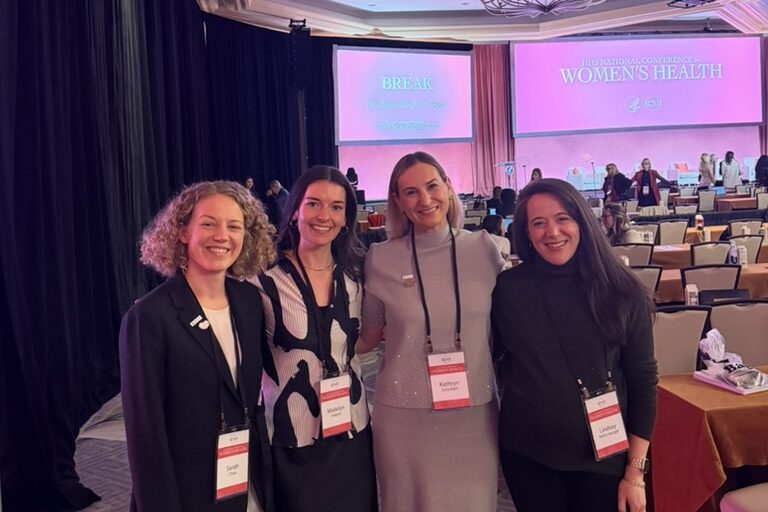
Photo: SWHR staff in attendance at the HHS inaugural National Conference on Women’s Health.
By Madelyn Adams, MPA, Public Policy and Advocacy Manager
In March, the U.S. Department of Health and Human Services (HHS) hosted the inaugural National Conference on Women’s Health, an event that drew curious attendees from across the nation and elevated the national conversation around women’s health. The event also demonstrated that women’s health research is an issue that transcends party and crosses administrations.
Details surrounding the conference were sparse until just days before it began. Once the conference kicked off, it revealed an event aligned with the administration’s public health priorities, such as chronic disease prevention, lifestyle-based and holistic approaches to health, the impacts of environmental exposures to health, and promoting research that is reproducible and replicable (for more information, read SWHR’s recap of the “Make America Healthy Again” report).
Throughout the three-day event, panel discussions and featured speakers reinforced this direction. Themes of “gold-standard” science, proactive approaches to preventing and managing chronic disease, and increased support for families navigating fertility and reproductive health were consistent throughlines, underscoring a broader recalibration of federal attention in these areas.
Women’s Health Research at the NIH
During a fireside chat between Jay Bhattacharya, MD, PhD, National Institutes of Health (NIH) Director, and Nicole Kleinstreuer, PhD, NIH Deputy Director for Program Coordination, Planning, and Strategic Initiatives, Dr. Bhattacharya called for a reevaluation of persistent gaps in federal research, acknowledging that women’s health has long been underfunded and too narrowly framed. He pointed to a clear shift in priorities, with conditions like cardiovascular disease and autoimmune diseases now being treated as core components of women’s health rather than secondary concerns. Dr. Kleinstreuer highlighted the value of initiatives like All of Us and the Environmental influences on Child Health Outcomes (ECHO) Program in generating large-scale population insights, alongside newer programs aimed at turning research findings into practical clinical and community-based applications. Throughout the discussion, a consistent theme was the need to recognize and validate patient experiences. As Dr. Kleinstreuer put it, “invisible illness requires visible science.”
Women’s Health Across the Lifespan
Another central theme throughout the conference was the importance of approaching women’s health with a lifespan lens, paying particular attention to menopause and reproductive health – namely, infertility.
Menopause emerged as a major area of focus, highlighted at the conference through a dedicated panel and woven into broader session discussions. Speakers discussed evolving perspectives on hormone therapy, including the HHS’s removal of the black box warning from estrogen-based therapies, the importance of timing when initiating treatment for menopause symptoms, and the need for further research on the safe use of vaginal estrogen. Alongside clinical interventions, there was a strong emphasis on longevity and the role of lifestyle strategies in supporting healthy aging.
Meanwhile, a panel discussion on infertility underscored early detection and management of chronic conditions that often underlie reproductive challenges. Panelists noted that infertility can be a downstream consequence of delayed diagnoses of conditions such as polycystic ovary syndrome (PCOS) and endometriosis, pointing to gaps in timely care. Improved care coordination – particularly stronger coordination between gynecology and primary care – was identified as a key opportunity to improve patient outcomes. While much of the discussion centered on endometriosis, there was limited exploration of other chronic conditions that may also contribute to infertility, suggesting an opportunity for new research investment.
Innovation and Private Partnerships
A recurring theme throughout the conference was the persistent challenge of translating scientific discovery into meaningful real-world impact. Speakers emphasized that accelerating innovation in women’s health will require improved coordination across federal agencies, paired with more deliberate and strategic partnerships with the private sector. At the same time, industry leaders underscored the need for a cultural shift toward a “fail forward” mindset, noting that progress in women’s health has historically lagged in part due to a more cautious, risk-averse approach to investment and development.
Another clear throughline was the administration’s growing focus on digital health and wearable technologies as central pillars of its broader public health agenda. These technologies align closely with the administration’s emphasis on harnessing real-time data to improve prevention and enable earlier diagnosis.
Amidst what was largely an optimistic conversation, participants acknowledged several enduring structural barriers. For example, limited reimbursement pathways for women’s health services, fragmented and non-interoperable data systems, and the continued underrepresentation of women in clinical trials were repeatedly cited as challenges. Addressing these gaps, speakers argued, is essential to fully realize the promise of women’s health innovation.
Building a More Complete Women’s Health Framework
All in all, the conference covered a broad spectrum of issues that are often sidelined in conversations about women’s health – like cardiovascular health, cognitive health, and mental health – while placing particular and repeated emphasis on key stages of the women’s health lifecycle, such as fertility, menopause, and hormone-related care. This signaled a growing recognition that women’s health is not limited to conditions unique to the female sex but rather applies to all aspects of the body across the lifespan. Taken together, these discussions reflect a broader shift toward prevention, earlier intervention, and more coordinated systems of care. This approach aligns with an increasing focus on addressing root causes and supporting women’s health needs comprehensively at every stage of life, rather than responding to issues only once they become acute.
Building on this year’s conference, should HHS make this an annual event, the Society for Women’s Health Research (SWHR) believes there are several opportunities to strengthen the agenda. First, this conference provides an optimal opportunity for the government to highlight the work of the NIH Office of Research on Women’s Health and the U.S. Food and Drug Administration’s Office of Women’s Health, as neither Office was on stage during the conference. SWHR strongly recommends incorporating both into the agenda. Additionally, providing action steps, such as how patient advocacy organizations, medical professional societies, and research entities could more effectively partner with federal agencies, would complement the day’s discussions. Finally, it would be helpful to hear from HHS how they intend to measure progress and outcomes of the initiatives discussed.
SWHR hopes to see this conference—and the national focus on women’s health—continue in the years to come and remains committed to working with HHS to move the needle forward in women’s health and ensure that conversations are anchored in science and grounded by evidence.