

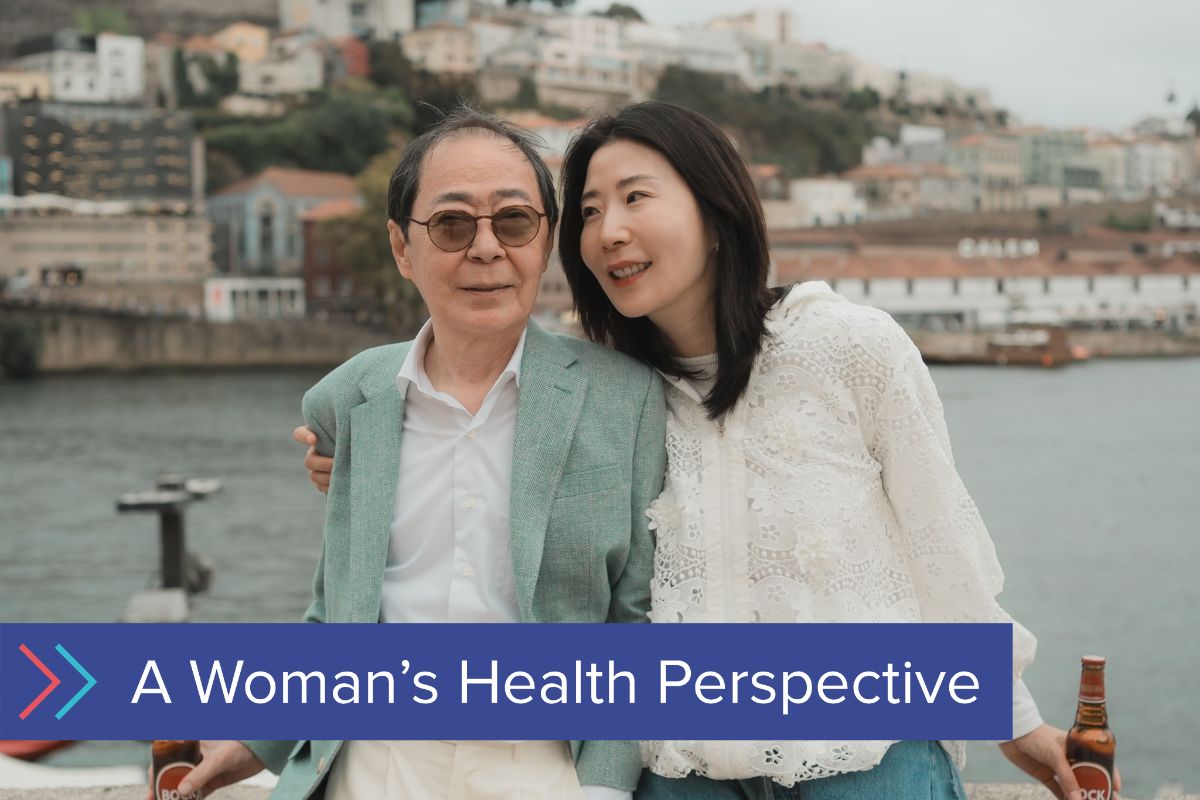
This is a firsthand account submitted through SWHR’s Share Your Story portal, as part of SWHR’s Women’s Health Perspective series.
My mother was diligent about her health. She lived in South Korea, where health care access is easy, and she went to the hospital regularly. When she began experiencing significant back pain, she told her physician. He told her to golf less.
A month later, she was diagnosed with stage 4 pancreatic cancer.
She had done everything right. She showed up, spoke up, and was dismissed. Watching her go through that — and losing her — changed how I thought about my own health. After she passed, I finally went to the doctor for a comprehensive checkup. I was 31 years old.
I was then diagnosed with ovarian cysts and uterine fibroids — conditions that were developing quietly, without a single symptom I could have named. I had laparoscopic surgery that left scars I still carry. Afterward, people asked if I had gotten liposuction, unable to see what the scars represented. That invisibility felt familiar.
After surgery, my body changed dramatically. Hot flashes. No period. My doctor was dismissive of me before I even finished my sentence. I was too young, he said. What I was describing wasn’t possible.
I knew something was wrong. I asked to be tested anyway.
My hormone levels came back at zero. My doctor was surprised. I wasn’t. I had known something was happening — I simply hadn’t had the piece of paper to prove it yet.
He prescribed hormone pills without addressing the cause. I didn’t fill the prescription. Instead, I turned to acupuncture, Korean medicine, and supplements recommended by women with similar experiences. Things slowly improved, but I never got real answers.
Every time I described my symptoms, the response began not with curiosity but with a conclusion: “You’re too young.” “It’s probably stress.” Not once did a clinical response begin with: “Your instinct might be right.”
I learned to bring data to every appointment — because a woman without numbers can be dismissed. A woman with numbers has standing.
I was finally told I was experiencing menopause in 2012 at the age of 33. I still live with the consequences today. Severe menopausal insomnia remains one of my most significant daily challenges. I also live with arthritis that developed in the years that followed. From the outside, none of this is visible. That gap — between how a woman presents and what she is actually carrying — is something I most want others to understand.
My mother went to her doctor regularly. She spoke up about her pain. She did everything right — and it still wasn’t enough. Her story is part of why I cannot stop asking these questions.
Her story has also made me into a caregiver, a role I embrace despite the difficulties.
When my mother passed, my father woke up alone for the first time in decades. And then, not long after, he woke up and couldn’t see. He kept asking me to turn the light on. The light was already on. That was how I learned that my father had lost most of his vision — diabetic retinopathy in both eyes, and neovascular glaucoma that had taken his right eye entirely. He cannot read, navigate unfamiliar spaces, or perform daily tasks independently. He requires a sighted guide. He is my daily task.
I am the one who cooks, cleans, manages appointments, and researches his nutritional needs. Not because anyone assigned it to me. Because I am a daughter, and somewhere I internalized that this is what daughters do — especially when there is no mother left to do it.
A few years ago, I came home from work and asked my father what was on his bucket list. He mentioned traveling the world. A Mediterranean cruise he had always wanted to take with my mother. None of it was possible on his own. And as long as I was working the way I was working, none of it was possible with me either. I knew that if I thought about it too long, I wouldn’t do it, so I booked the flights that night. The next morning, I walked into the office and told my boss I was leaving.
We traveled for fourteen weeks. Twenty-five countries. Forty cities. We took the fourteen-day Mediterranean cruise he had dreamed of. He could barely see — but he took photographs everywhere, enlarged them on his phone, and returned to them again and again. He told me constantly that he was happy. That this was everything. The only thing missing, he said, was my mother.
I did not want to have regrets. I don’t.
Today, my days look like this: breakfast before work, dinner when I come home regardless of the hour. On weekends, Redondo Beach — because my father loves crab. I don’t particularly like crab, but I sit across from him and remove every piece of meat from the shell so he can eat without struggling. Then I come home and eat whatever requires the least effort.
That is what I want to be honest about. When you are a sole caregiver working full-time, your own health becomes the thing you defer. You skip appointments. You eat convenience food while his meals are balanced. You ignore your body’s signals because there is always something more pressing.
But remember this: You cannot give from empty. Your health is not a luxury — it is the infrastructure everything else runs on.
Find one thing you will not compromise on for yourself. One appointment. One meal made with the same care you give to the person you love. Invisible labor does not distribute itself.
My father is loved and cared for. He gets his crab. He goes back to his photographs from the Mediterranean and remembers being happy. I am still learning how to extend that same care to myself.
I continue to read, research, and track my own health data. The clinical system has not always been designed to see me clearly, so I have learned to see myself.
To other women, I say: Start early. Don’t wait for symptoms. Get regular testing — even when you feel fine, it gives you a baseline that becomes invaluable later. The problems often begin before the symptoms do. Trust your instincts. You know your body better than anyone in any examination room. Push for the data. You may not fit neatly into a textbook presentation. That doesn’t mean nothing is happening.
Women deserve the chance to know what is happening in their bodies, before they have no choice but to find out.