Understanding Sex Differences in Obesity

Fact Sheets

Published 6/2/26

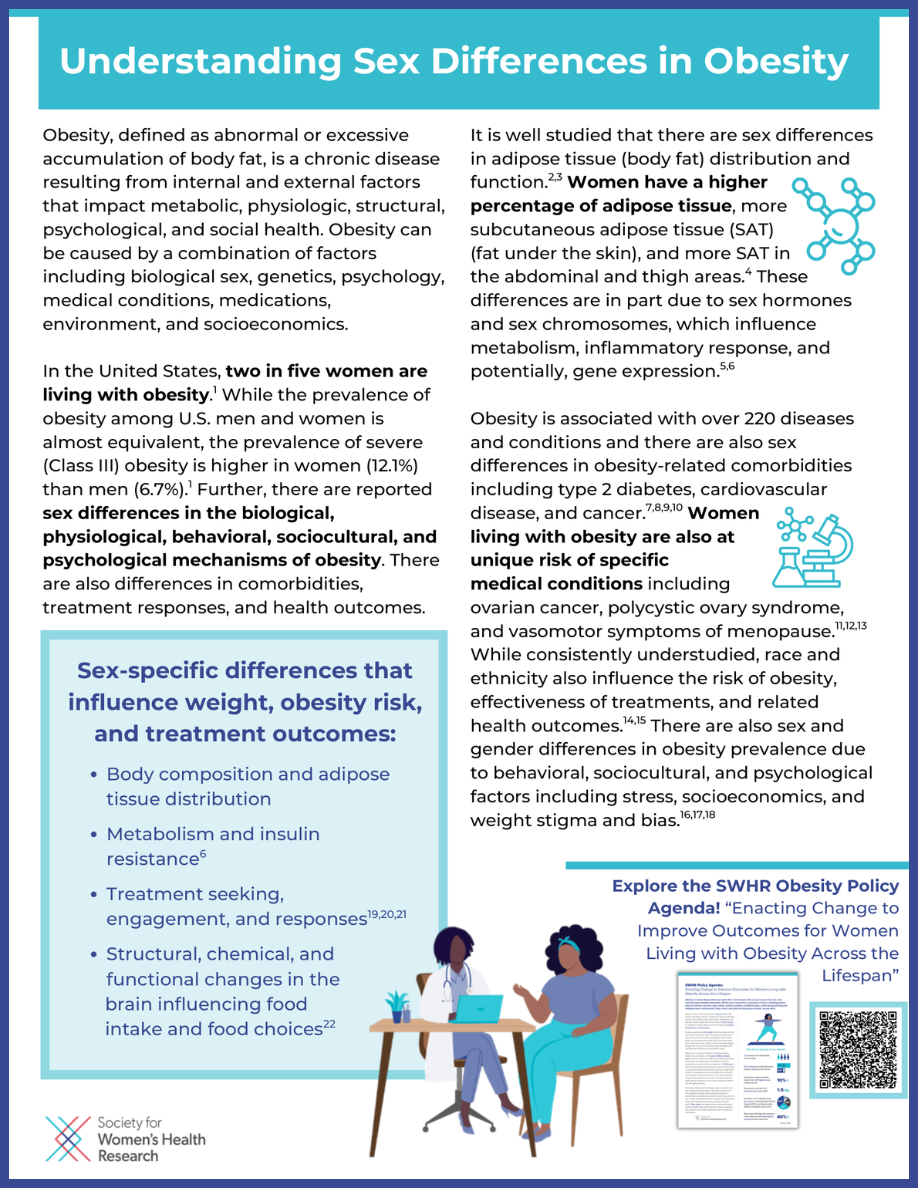
Obesity is a chronic disease that results from both internal and external factors, ultimately impacting an individual’s metabolic (relating to metabolism), physiologic (relating to the body’s normal functioning), structural (relating to the physical body), psychological (relating to the mind or emotional state), and social health.

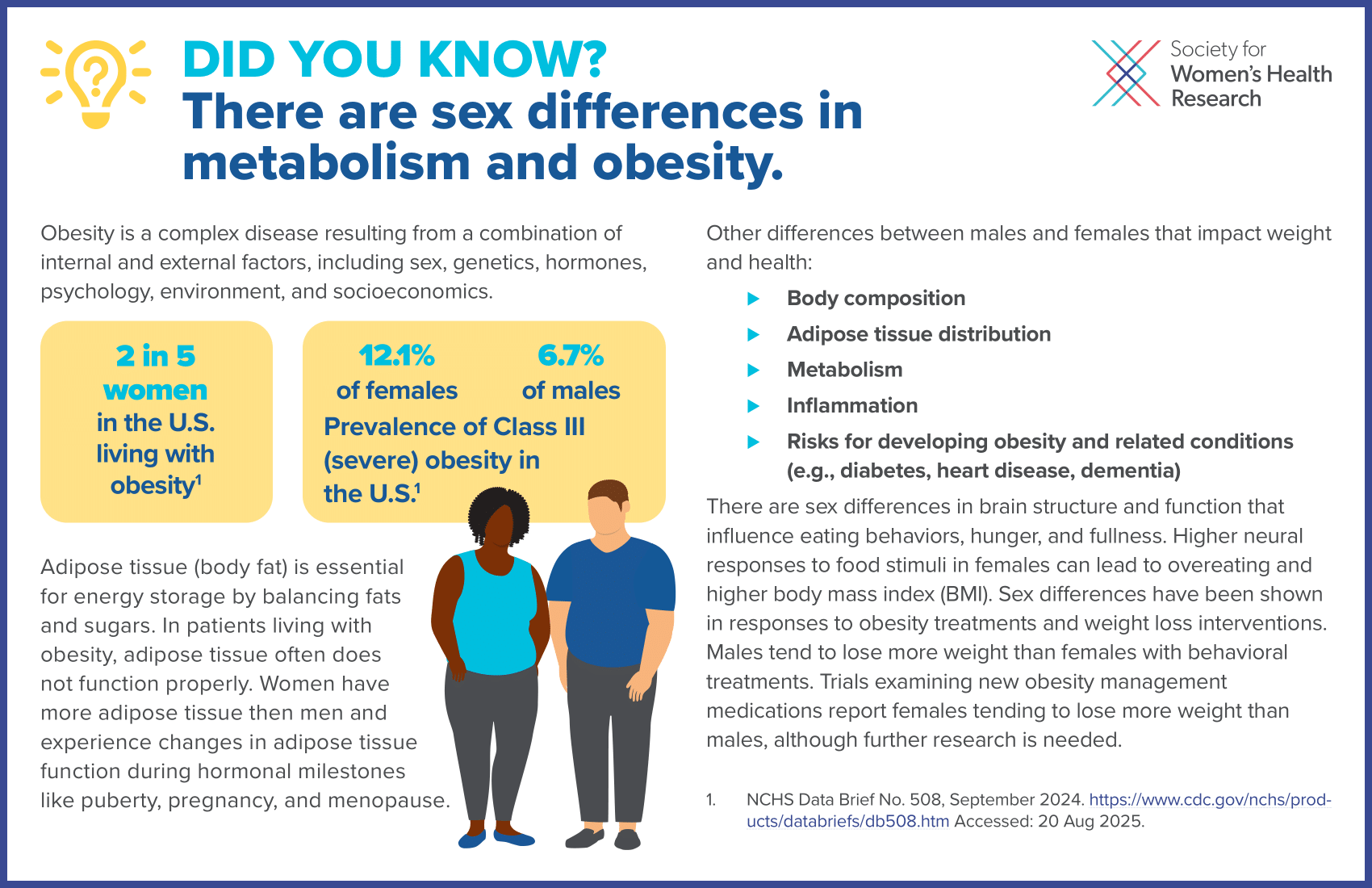
In the United States, two in five women are living with obesity. While the prevalence of obesity among U.S. men and women is almost equivalent, the prevalence of types of obesity and its impact on patients differs between men and women. The “Understanding Sex Differences in Obesity” fact sheet explores these differences.

Download Fact Sheet

Fact Sheet References

  1. Emmerich, S. D., Fryar, C. D., Stierman, B., & Ogden, C. L. (2024). Obesity and severe obesity prevalence in adults: United States, August 2021-August 2023. NCHS Data Brief, 508. https://doi.org/10.15620/CDC/15928
  2. Link, J. C., Hasin-Brumshtein, Y., Cantor, R. M., Chen, X., Arnold, A. P., Lusis, A. J., & Reue, K. (2017). Diet, gonadal sex, and sex chromosome complement influence white adipose tissue miRNA expression. BMC Genomics, 18(1). https://doi.org/10.1186/S12864-017-3484-1
  3. Chang, E., Varghese, M., & Singer, K. (2018). Gender and sex differences in adipose tissue. Current Diabetes Reports, 18(9). https://doi.org/10.1007/S11892-018-1031-3
  4. Karastergiou, K., Smith, S. R., Greenberg, A. S., & Fried, S. K. (2012). Sex differences in human adipose tissues – The biology of pear shape. Biology of Sex Differences, 3(1). https://doi.org/10.1186/2042-6410-3-13
  5. Link, J. C., & Reue, K. (2017). Genetic basis for sex differences in obesity and lipid metabolism. Annual Review of Nutrition, 37, 225–245. https://doi.org/10.1146/ANNUREV-NUTR-071816-064827
  6. Zore, T., Palafox, M., & Reue, K. (2018). Sex differences in obesity, lipid metabolism, and inflammation—A role for the sex chromosomes? Molecular Metabolism, 15, 35–44. https://doi.org/10.1016/J.MOLMET.2018.04.003
  7. Yuen, M. M. A. (2023). Health complications of obesity: 224 obesity-associated comorbidities from a mechanistic perspective. Gastroenterology Clinics of North America, 52(2), 363–380. https://doi.org/10.1016/J.GTC.2023.03.006
  8. Tramunt, B., Smati, S., Grandgeorge, N., Lenfant, F., Arnal, J. F., Montagner, A., & Gourdy, P. (2019). Sex differences in metabolic regulation and diabetes susceptibility. Diabetologia, 63(3), 453–461. https://doi.org/10.1007/S00125-019-05040-3
  9. Faulkner, J. L., & Belin De Chantemèle, E. J. (2018). Sex differences in mechanisms of hypertension associated with obesity. Hypertension, 71(1), 15–21. https://doi.org/10.1161/HYPERTENSIONAHA.117.09980
  10. Sung, H., Siegel, R. L., Torre, L. A., Pearson‐Stuttard, J., Islami, F., Fedewa, S. A., Goding Sauer, A., Shuval, K., Gapstur, S. M., Jacobs, E. J., Giovannucci, E. L., & Jemal, A. (2019). Global patterns in excess body weight and the associated cancer burden. CA: A Cancer Journal for Clinicians, 69(2), 88–112. https://doi.org/10.3322/CAAC.21499
  11. Ollila, M. M. E., Piltonen, T., Puukka, K., Ruokonen, A., Järvelin, M. R., Tapanainen, J. S., Franks, S., & Morin-Papunen, L. (2016). Weight gain and dyslipidemia in early adulthood associate with polycystic ovary syndrome: prospective cohort study. The Journal of Clinical Endocrinology & Metabolism, 101(2), 739–747. https://doi.org/10.1210/JC.2015-3543
  12. Liu, Y., Metzinger, M. N., Lewellen, K. A., Cripps, S. N., Carey, K. D., Harper, E. I., Shi, Z., Tarwater, L., Grisoli, A., Lee, E., Slusarz, A., Yang, J., Loughran, E. A., Conley, K., Johnson, J. J., Klymenko, Y., Bruney, L., Liang, Z., Dovichi, N. J., … Stack, M. S. (2015). Obesity contributes to ovarian cancer metastatic success through increased lipogenesis, enhanced vascularity, and decreased infiltration of M1 macrophages. Cancer Research, 75(23), 5046–5057. https://doi.org/10.1158/0008-5472.CAN-15-0706
  13. Namgoung, S., Chang, Y., Woo, C. Y., Kim, Y., Kang, J., Kwon, R., Lim, G. Y., Choi, H. R., Kim, K. H., Kim, H., Hong, Y. S., Zhao, D., Cho, J., Guallar, E., Park, H. Y., & Ryu, S. (2022). Metabolically healthy and unhealthy obesity and risk of vasomotor symptoms in premenopausal women: cross-sectional and cohort studies. BJOG: An International Journal of Obstetrics and Gynaecology, 129(11), 1926–1934. https://doi.org/10.1111/1471-0528.17224
  14. Hales, C. M., Carroll, M. D., Fryar, C. D., & Ogden C. L. (2020). Prevalence of obesity and severe obesity among adults: United States, 2017-2018. NCHS Data Brief, 360.
  15. Min, J., Goodale, H., Xue, H., Brey, R., & Wang, Y. (2021). Racial-ethnic disparities in obesity and biological, behavioral, and sociocultural influences in the United States: A systematic review. Advances in Nutrition, 12(4), 1137–1148. https://doi.org/10.1093/ADVANCES/NMAA162
  16. Puhl, R. M., Himmelstein, M. S., & Pearl, R. L. (2020). Weight stigma as a psychosocial contributor to obesity. The American Psychologist, 75(2), 274–289. https://doi.org/10.1037/AMP0000538
  17. Ogden, C. L., Lamb, M. M., Carroll, M. D., & Flegal, K. M. (2010). Obesity and socioeconomic status in adults: United States 1988-1994 and 2005-2008. NCHS Data Brief, 50.
  18. Du, C., Adjepong, M., Zan, M. C. H., Cho, M. J., Fenton, J. I., Hsiao, P. Y., Keaver, L., Lee, H., Ludy, M. J., Shen, W., Swee, W. C. S., Thrivikraman, J., Amoah-Agyei, F., de Kanter, E., Wang, W., & Tucker, R. M. (2022). Gender differences in the relationships between perceived stress, eating behaviors, sleep, dietary risk, and body mass index. Nutrients, 14(5). https://doi.org/10.3390/NU14051045
  19. Tsai, S. A., Lv, N., Xiao, L., & Ma, J. (2016). Gender differences in weight-related attitudes and behaviors among overweight and obese adults in the United States. American Journal of Men’s Health, 10(5), 389–398. https://doi.org/10.1177/1557988314567223
  20. Christensen, P., Meinert Larsen, T., Westerterp-Plantenga, M., Macdonald, I., Martinez, J. A., Handjiev, S., Poppitt, S., Hansen, S., Ritz, C., Astrup, A., Pastor-Sanz, L., Sandø-Pedersen, F., Pietiläinen, K. H., Sundvall, J., Drummen, M., Taylor, M. A., Navas-Carretero, S., Handjieva-Darlenska, T., Brodie, S., … Raben, A. (2018). Men and women respond differently to rapid weight loss: Metabolic outcomes of a multi-centre intervention study after a low-energy diet in 2500 overweight, individuals with pre-diabetes (PREVIEW). Diabetes, Obesity and Metabolism, 20(12), 2840–2851. https://doi.org/10.1111/DOM.13466
  21. Aronica, L., Rigdon, J., Offringa, L. C., Stefanick, M. L., & Gardner, C. D. (2021). Examining differences between overweight women and men in 12-month weight loss study comparing healthy low-carbohydrate vs. low-fat diets. International Journal of Obesity, 45(1), 225–234. https://doi.org/10.1038/S41366-020-00708-Y
  22. Kroll, D. S., Feldman, D. E., Biesecker, C. L., McPherson, K. L., Manza, P., Joseph, P. V., Volkow, N. D., & Wang, G. J. (2020). Neuroimaging of sex/gender differences in obesity: a review of structure, function, and neurotransmission. Nutrients, 12(7), 1–21. https://doi.org/10.3390/NU12071942

This document is intended to serve as an educational and informative resource and is not intended or implied to serve as a substitute for medical or professional advice. The Society for Women’s Health Research does not make medical, diagnosis, or treatment recommendations, nor does it endorse or promote specific screening or diagnostic tests. Patients and consumers should confirm information and consult a professional health care provider to determine individual needs. The Society will not be liable for any direct, indirect, or other damages arising therefrom.

This material was created by the Society for Women’s Health Research (SWHR) and is intended to serve as a public educational and informative resource. This material may be cited or shared on external channels, websites, and blogs, with attribution given to SWHR, or printed and displayed in its original formatted version. SWHR encourages the sharing and reposting of its content in order to spread awareness around women’s health issues. For specific questions about sharing SWHR content, please reach out to communications@swhr.org.

Sponsor

Support for this educational program has been provided by Novo Nordisk. SWHR maintains independence and editorial control over program development, content, and work products.