

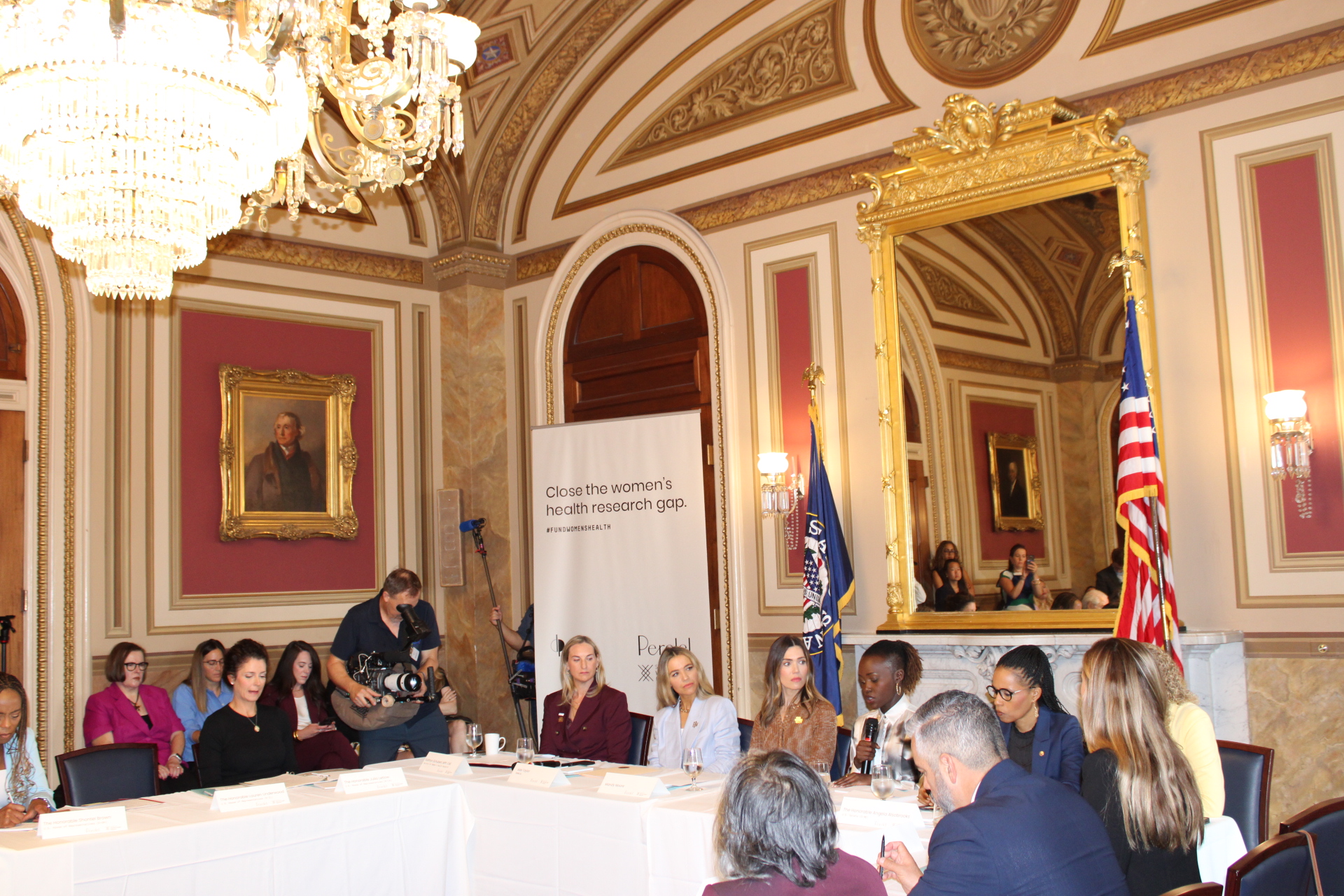
On Tuesday, September 16, a powerful coalition of congressional champions, women’s health advocates, and award-winning actresses Mandy Moore and Lupita Nyong’o gathered for a conversation about the urgent need to fund women’s health research.
The women’s health research congressional roundtable and advocacy day, held on Capitol Hill and co-hosted by the Society for Women’s Health Research (SWHR) and vitamin company Perelel, brought together voices from across the country and across disciplines to elevate the need for funding women’s health research. Currently, less than 10% of National Institutes of Health (NIH) funded research goes towards women’s health, leaving critical gaps in understanding not only how conditions affect women, but also why they occur and how they should be diagnosed, treated, and managed. Happening two weeks before the key appropriations deadline of September 30, the event was an opportune time to discuss the impacts of chronic underfunding with congressional appropriators and policymakers.
Perelel co-Founder Alex Taylor opened the conversation by emphasizing the importance of investing in innovation, research, and care designed for women and by women. “We are here today because women’s health has been overlooked for too long,” Taylor said. SWHR President and CEO Kathryn Schubert, MPP, CAE, followed by highlighting the value of women’s health research: “The more we understand not just about women’s bodies, but also the differences between men and women, the more we will be able to advance the health of everyone.”
Emphasizing the real-world impacts of the topic at hand, Moore shared her own fertility journey, recounting how she was initially told by a specialist that she might have endometriosis, a condition in which tissue that resembles that in the lining of the uterus grows outside the uterus, often leading to challenges with infertility. Shortly thereafter, Moore found out she was pregnant. While Moore was not ultimately diagnosed with endometriosis and now has three children, this experience highlighted the complexities and uncertainties so many women face in navigating their health. “My doctor didn’t have the language to explain to me what was wrong,” Moore noted in an interview with ABC News. From sharing her story with others, Moore came to the realization that “experiences like mine were not rare.”
Nyong’o also discussed her health journey, citing her story as a “living example of someone who has shouldered the consequences of the research gap.” After being diagnosed with uterine fibroids – a condition that impacts at least 26 million women in the United States – in 2014, the same year that Nyong’o won an Academy Award, she was informed by her physician that she only had two options: undergo invasive surgery or live with the pain. While Nyong’o opted for surgery, she was shocked to learn that, even with surgical intervention, it was likely that her fibroids would return.
Moore’s and Nyong’o’s experiences, like so many others, underscored a reality that was echoed by others in the room. Congresswoman Debbie Wasserman Schultz (D-FL) spoke candidly about her breast cancer diagnosis, her discovery of a high genetic risk for the BRCA gene mutation, and her decision to undergo a double mastectomy. Congresswoman Ayanna Pressley (D-OH) highlighted the emotional burden of women’s health challenges, saying, “behind every statistic is a life – connected to a family, connected to a community.” She also emphasized the shame too often woven into women’s health experiences, urging, “No to the suffering and the shame. Yes to research and change.”
These stories illuminated a broader truth: millions of women endure medical confusion, misdiagnoses, or a lack of options simply because research into women-specific conditions remains insufficient.
Senator Angela Alsobrooks (D-MD) called for bipartisan, bicameral support for women’s health research funding during the roundtable, which was echoed by Congressman Juan Ciscomani (R-AZ), who emphasized the need for men to also champion the issue. Congresswoman Julia Letlow (R-LA) expanded on this discourse by remarking that women aren’t just patients, but they need to be part of the solution, too. She called for more women to pursue careers in health care and research to ensure that the future of medicine reflects the needs of all.
Other members present included Congresswoman Shontel Brown (D-OH), Congresswoman Bonnie Watson Coleman (D-NJ), Congresswoman Teresa Leger Fernández (D-NM), and Congresswoman Robin Kelly (D-NY).
The conversation then shifted to patient advocacy and researcher perspectives, highlighting a range of conditions areas that disproportionately, differently, or uniquely affect women, including Alzheimer’s disease, autoimmune disease, bone and heart health, uterine fibroids, and menopause.
Rebecca C. Thurston, PhD, Assistant Dean for Women’s Health Research at the University of Pittsburgh School of Medicine, Assistant Dean for Women’s Health Research, Pittsburgh Foundation Endowed Chair for Women’s Health & Dementia; Distinguished Professor, and Director of the Center for Women’s Biobehavioral Health at University of Pittsburgh, pointed to a deeper cultural issue: “We have a high cultural tolerance for women’s suffering.” She emphasized that researchers are ready and eager to address women’s health issues — they just need the funding to do so.
The event closed with a clear call to action: advocates must work with Congress to develop and commit to an actionable plan for change. Nyong’o put it simply: “Women’s health is not a special interest. It is foundational to the investment in our nation’s well-being.”
Following the roundtable, Moore, Nyong’o, and representatives from the SWHR and Perelel teams also attended a series of Hill and administration meetings. Meetings were held with Senator Susan Collins (R-ME); Senator Patty Murray (D-WA); Alison Cernich, PhD, Acting Director of the Eunice Kennedy Shriver National Institute of Child Health and Human Development at NIH; and Janine Clayton, MD, FARVO, Associate Director for Research on Women’s Health and Director of the Office of Research on Women’s Health at NIH. The conversations centered around what policymakers were prioritizing with respect to women’s health research funding and opportunities for collaboration.
Check out photos from the day’s roundtables and meetings here.
Watch ABC News’ exclusive coverage of the event here.
SWHR is grateful for our partners at Perelel and for those who were able to join for the conversation. As always, we remain committed to keeping the conversation going and advocating year-round for funding for women’s health research.