

By Sarah Chew, MPH, SWHR Science Programs Manager and Syreen Goulmamine, MPH, SWHR Science Programs Manager
This June, the Society for Women’s Health Research (SWHR) attended the Organization for the Study of Sex Differences (OSSD) 2025 Annual Meeting in Albuquerque, New Mexico. SWHR, alongside the Women’s Health Research Cluster, Womenmind at CAMH, and Elsevier, kicked off the annual meeting with a pre-conference symposium, “Beyond Sex Differences: A Spotlight on Women’s Health Research.” The symposium brought together experts to examine questions about women’s health research and share the latest findings in their respective fields and research areas.
Marija Kundakovic, PhD, provided the symposium’s keynote, “Leveraging Mouse and Human (Epi)Genomics to Improve Women’s Mental Health,” where she highlighted the molecular basis of anxiety and depression, which involves critical gene-stress interactions and sex hormone fluctuations, that contribute to a higher prevalence in women. The keynote offered opportunities to investigate why current treatments fail one-third of psychiatric patients.
Throughout the symposium, experts also shared research on obesity and metabolism, perinatal mental health, polycystic ovary syndrome, and brain health. SWHR Chief Science Officer Irene O. Aninye, PhD, and Science Programs Manager Syreen Goulmamine, MPH, presented “Science that Speaks: Advancing Research Priorities in Women’s Obesity Care,” where they discussed advances, challenges, and opportunities to address obesity in women.
Dr. Aninye’s talk, “Calling for Change: Elevating the Women’s Health Lens in Obesity Research,” highlighted gaps in research funding, underrepresentation of women in clinical trials, and how sex hormones influence body composition across the lifespan. She underscored the systemic shortcomings in clinical care – from outdated body mass index (BMI) metrics to inadequate insurance coverage – and challenged the research community to address stigma, expand access, and build equitable obesity policies that reflect biological realities and social determinants.
Goulmamine followed with a dynamic session, “Communicating for Change: Maximizing Accuracy, Impact, and Reach,” that discussed the importance of translating science into action through effective communication. She shared strategies, considerations, and resources for researchers to help explain the impact of their work, emphasizing the importance of crafting messages that resonate with diverse stakeholders to promote obesity research in women’s health. She encouraged researchers to reframe their findings using storytelling and shared priorities that could drive funding and shift policy. Further, her session aimed to empower researchers to elucidate why their work is critical to addressing gaps in women’s obesity research and, by extension, women’s health as whole. Her key takeaway was that scientific rigor is only impactful if it is understood, trusted, and enacted.
To open the official OSSD Annual Meeting, Liisa Galea, PhD, gave the Arthur P. Arnold Distinguished Lecture, “Unlocking Precision Medicine: How Sex and Women’s Health Factors are Key to Effective Translation.” In her powerful talk, Dr. Galea spotlighted the long-standing neglect of women’s mental health in neuroscience and psychiatry. She emphasized that despite clear sex differences in neuroscience and psychiatry, fewer than 5% of studies meaningfully account for sex, and even fewer consider female-specific factors like pregnancy or menopause. By demonstrating that not all estrogens act the same and that experiences like pregnancy can change how the brain responds to hormones, Dr. Galea called for a more nuanced, precision medicine approach that embraces hormone and life-stage diversity to close critical treatment gaps for women. She also emphasized the role of science communication in continuing to promote women’s health research as part of her keynote.
Dr. Galea’s remarks were echoed throughout the rest of the annual meeting, with many presenters reinforcing her message that sex differences research must be properly translated and disseminated for the betterment of all people. Across disciplines and topic areas, the meeting presenters highlighted key findings, gaps, and opportunities for collaboration. Notable presentations included Hot Topics from Biology of Sex Differences, with Ece Bayram, MD, PhD, who presented on clinical correlates and diagnosis of Lewy body dementia. Sharanya Ramesh, MD, PhD, FRCPC, presented on sex hormones and kidney disease and Sandra M Dumanski, MD, MSc, FASN, FRCPC, discussed reproductive care and cardiovascular health during the OSSD Presidential Symposium. The Office of Research on Women’s Health at the National Institutes of Health also held a policy award session featuring awardees Amanda Koire, MD, PhD, and Nefia Chacko with presentations on two critical topics: mental health and menopause, respectively.
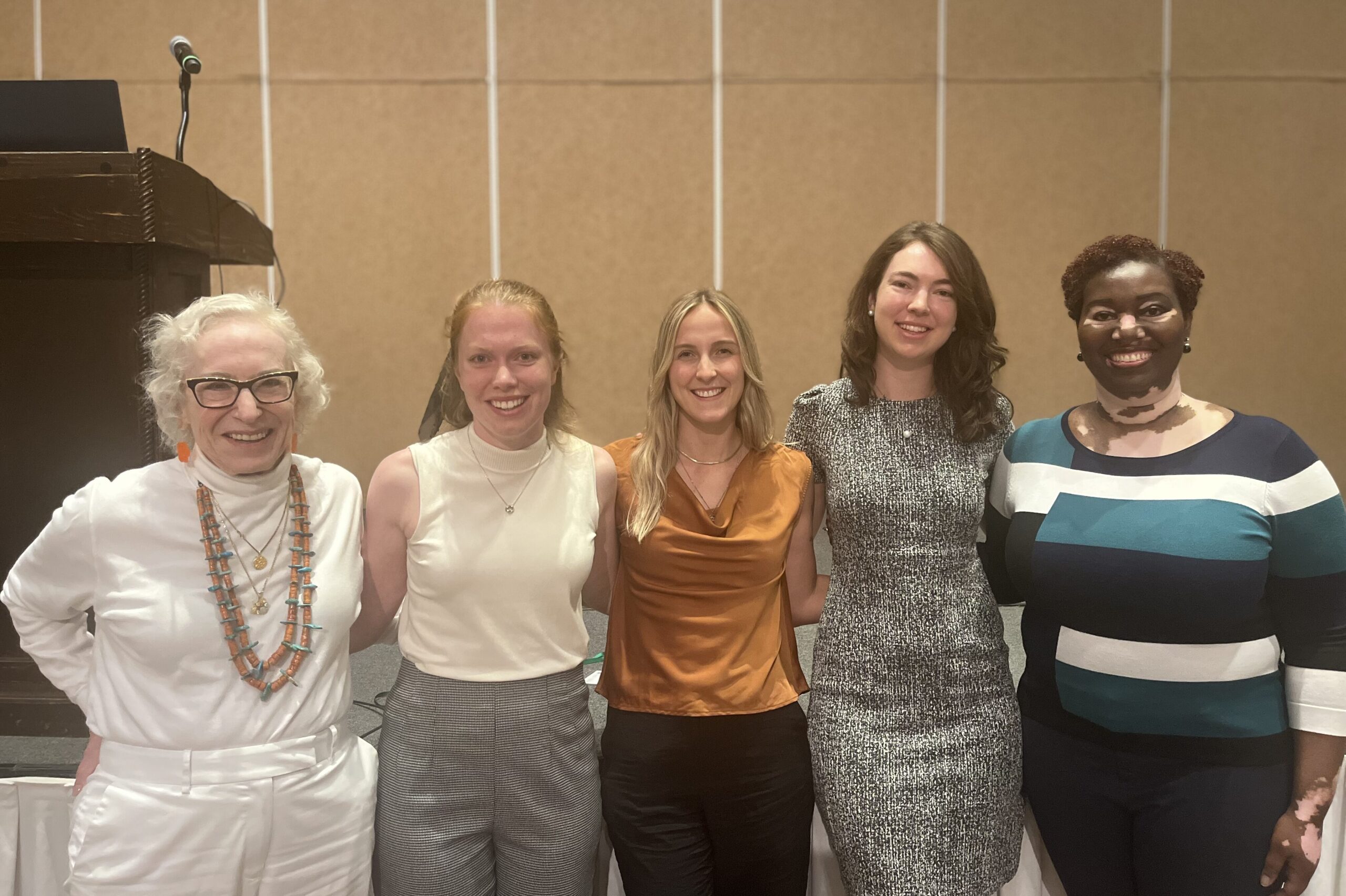
Also during the meeting, SWHR hosted the “Emerging Scholars in Women’s Health Research Award Symposium.” The 2025 awardees, Elizabeth Andrews, Kathryn Bates, and Nora Wolcott presented on brain health and women. With a diverse demonstration of topics and expertise, this symposium underscored that investigation and innovation in women’s brain health is much needed. As Dr. Aninye shared, “there is great opportunity for research that can help inform how we address brain health as individuals develop and age.” Awardees presented research specifically on Alzheimer’s disease and down syndrome, traumatic brain injury, and the hippocampus and pregnancy. [Pictured at top of blog (left to right): SWHR Founder Florence Haseltine, PhD, MD; awardees Kathryn Bates, Nora Wolcott, and Elizabeth Andrews; and Dr. Aninye.]
The OSSD Annual Meeting concluded with a final session that focused on “Advancing Integration of Sex and Gender in Research and Clinical Practice Through Whole-Sector Action and Policy Change.” Presenters discussed the role of policy and advocacy while using AI in sex differences research; cardiovascular health research and practice in women; and menopause in the workplace. During this session and throughout the conference, SWHR greatly valued the time OSSD dedicated to topics in sex differences research, aligning with the Society’s research interests and priorities areas moving forward.