

Above: Senator Gary Peters accepts an award from CEO Kathryn Schubert (second from left) during the February 2025 Heart Health Hill Day
On Wednesday, February 26, 2025, the Society for Women’s Health Research (SWHR), alongside key partners from the American Heart Association, the Association of Black Cardiologists, Inc., and WomenHeart, took to Capitol Hill to advocate for women’s heart health.
As the leading cause of death for women, heart disease continues to demand attention and action from policymakers. Despite the toll of heart disease on women across the nation, only about half of U.S. women recognize heart disease is their number one killer, and disparities exist in research and clinical care. Women are more likely than men to experience missed or delayed heart disease diagnoses, are less likely than men to receive guideline-directed medical therapies and interventions for heart disease and, on average, wait 11 minutes longer than men to receive emergency care when experiencing chest pain. These clinical gaps have dire consequences for women’s health, highlighting the critical need for immediate action.
But it doesn’t have to be this way. With increased funding for women’s heart health research and greater awareness, we can change the trajectory of women’s heart health outcomes.
During the Hill Day, advocates urged Congress to ensure that investments in women’s heart health research remain a top priority in fiscal year (FY) 2025 and FY 2026 spending bills. SWHR echoed the scientific and medical research community’s call to provide the National Institutes of Health (NIH) with $48.9 billion in base funding and the National Heart, Lung, and Blood Institute (NHLBI) with $4.281 billion to drive vital research in cardiovascular health.
However, such investments necessitate finalizing the FY 2025 appropriations process. While preventing a government shutdown is priority, continuing resolutions (CRs) have short- and long-term consequences for scientific progress. Ultimately, CRs create uncertainty for researchers relying on grant funding and disrupt ongoing research projects. Steady, timely investments in the scientific enterprise are vital to advancing understanding of the biological differences in health and disease, particularly as they affect women. Therefore, in conversations with congressional offices, advocates urged lawmakers to work together in a bipartisan manner to finalize FY 2025 appropriations swiftly.
Woven into advocates’ conversations with lawmakers was information about the gender-specific impacts of heart disease. Points that were raised included the fact that heart disease is the number one cause of maternal deaths and that postmenopausal women are at increased risk for heart disease due to the decline in estrogen production. But heart disease’s impacts don’t just affect women. Heart disease not only remains the overall leading cause of death in the United States, but it also imposes a significant economic burden across the health care system, costing approximately $252 billion annually—an alarming economic and human cost.
Honoring Heart Health Champions
Recognizing the immense burden of heart disease on women, as well as on men and the greater U.S. economy, SWHR was honored to use its Heart Health Hill Day to present Senator Gary Peters (D-MI) with a Heart Health Champion award in recognition of his efforts to designate September 2024 as National Cholesterol Education Month and support of heart health advocacy. He joins SWHR’s other Heart Health Champions Senator Hyde-Smith (R-MS) and Representatives Cherfilus-McCormick (D-FL-20) and Cammack (R-FL-3), who were presented with their awards from SWHR last fall. SWHR is grateful for all the congressmembers’ ongoing efforts to elevate the need for heart health awareness and education.
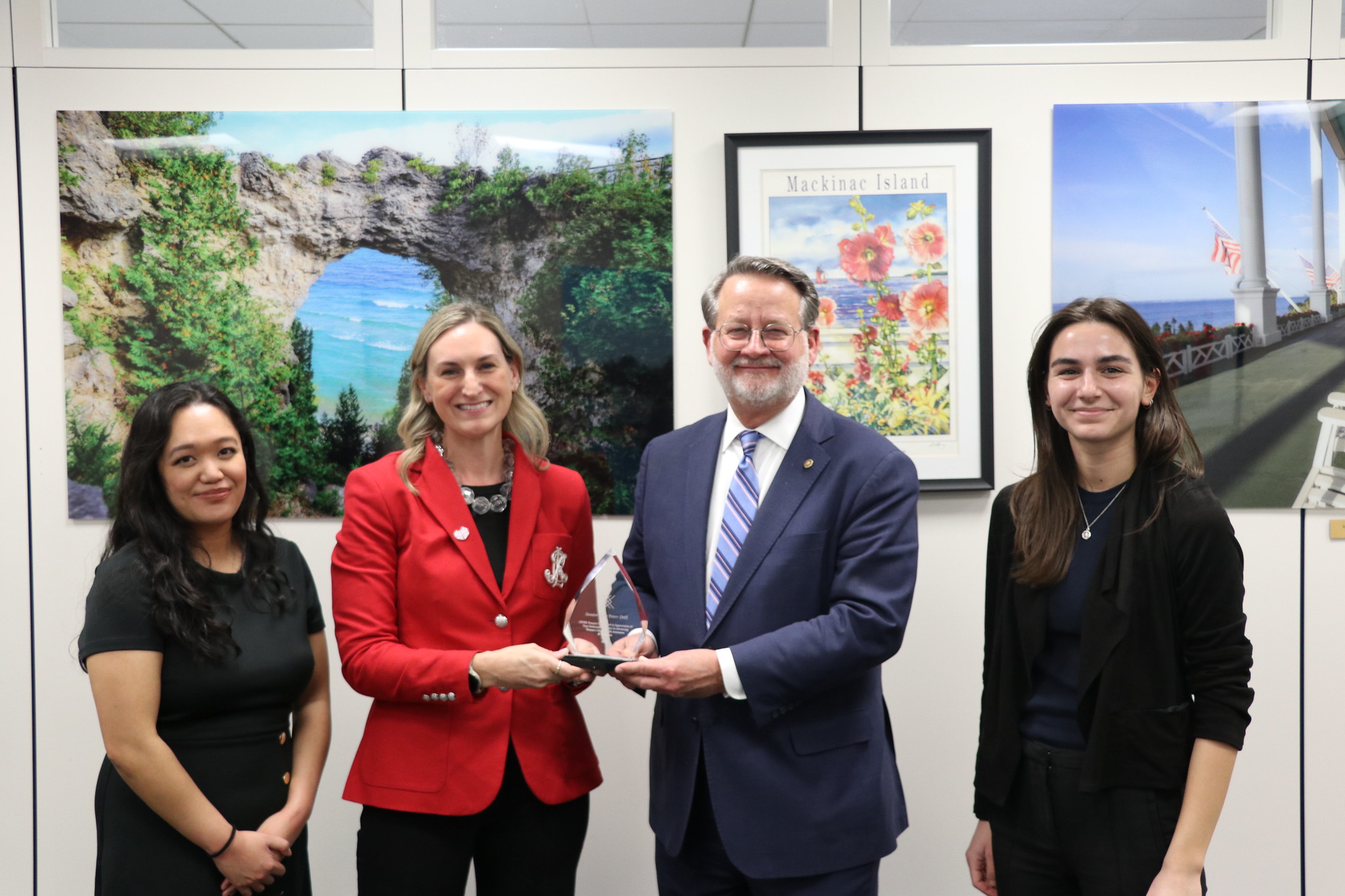
Senator Peters accepts an award from CEO Kathryn Schubert (second from left) during the February 2025 Heart Health Hill Day.

Staffers from Representatives Cherfilus-McCormick’s office accept an award on her behalf during a September 2024 breakfast reception.

Representative Cammack accepts a heart health champion award.

Senator Hyde-Smith accepts a heart health champion award.
SWHR looks forward to working with the 119th Congress to champion women’s heart health and women’s health research to create a healthier future for all. The path to address heart disease and improve heart health for all is a bipartisan one.
To learn more about women’s heart health and policy opportunities, check out SWHR’s policy agenda, Improving Women’s Heart Health Outcomes Across the Lifespan.
For questions, please contact SWHR’s policy team at policy@swhr.org.