


By Olivia Milne, Communications Intern
Innovative diagnostic research and technologies are essential to advancing women’s health. From screenings to biopsies, diagnostics provide critical insights that inform prevention, early intervention, and vital care decisions. Strengthening these options for women not only improves health outcomes but also plays a key role in reducing persistent health disparities.
This past year, the Society for Women’s Health Research (SWHR) Value of Diagnostics within Women’s Health series placed a special emphasis on maternal health. The 2025 series featured public forums focused on gestational diabetes and preeclampsia, alongside an in-depth fact sheet examining the value of diagnostics for preeclampsia. In collaboration with leading experts, discussions revealed a persistent gap in the diagnostic tools available and accessible during pregnancy, despite their potential to support millions of individuals. Across the program, speakers emphasized the massive benefits that more effective, personalized diagnostic approaches offer pregnant populations, improving both immediate outcomes and long-term health outcomes for mothers.
Improving Preeclampsia Detection and Follow-Up
Preeclampsia is a pregnancy-related condition characterized by high blood pressure that is estimated to affect 2% to 8% of all pregnancies worldwide. Ukachi N. Emeruwa, MD, MPH, opened SWHR’s “Applying Pressure to Diagnose Preeclampsia Better and Earlier” public forum with this figure, emphasizing that 60% of preeclampsia-related deaths are preventable. Dr. Emeruwa highlighted that prevention relies not only on blood pressure monitoring but also on a range of noninvasive tests, including urine analysis, platelet counts, liver function tests, and thorough patient symptom assessments. Yet, many postpartum patients fail to receive adequate follow-up care, an issue intensified for women facing social and economic vulnerabilities.
“It’s important to recognize that pregnant people are valuable beyond their pregnancy carrying capacity,” said Dr. Emeruwa, advocating for comprehensive postpartum preeclampsia care. “Part of reimagining care and innovation has to include transitions of care from maternal providers to providers who will care for patients after pregnancy,” she added.
Carl Weiner, MD, MBA, spoke next, emphasizing the importance of preventing the onset of preeclampsia in high-risk women through early therapeutic interventions, before the condition fully develops. Dr. Weiner highlighted that diagnostic options for detecting early-onset preeclampsia remain limited, despite strong evidence showing their potential to reduce the condition’s progression. He attributed these gaps to a broader lack of research and understanding surrounding preeclampsia.
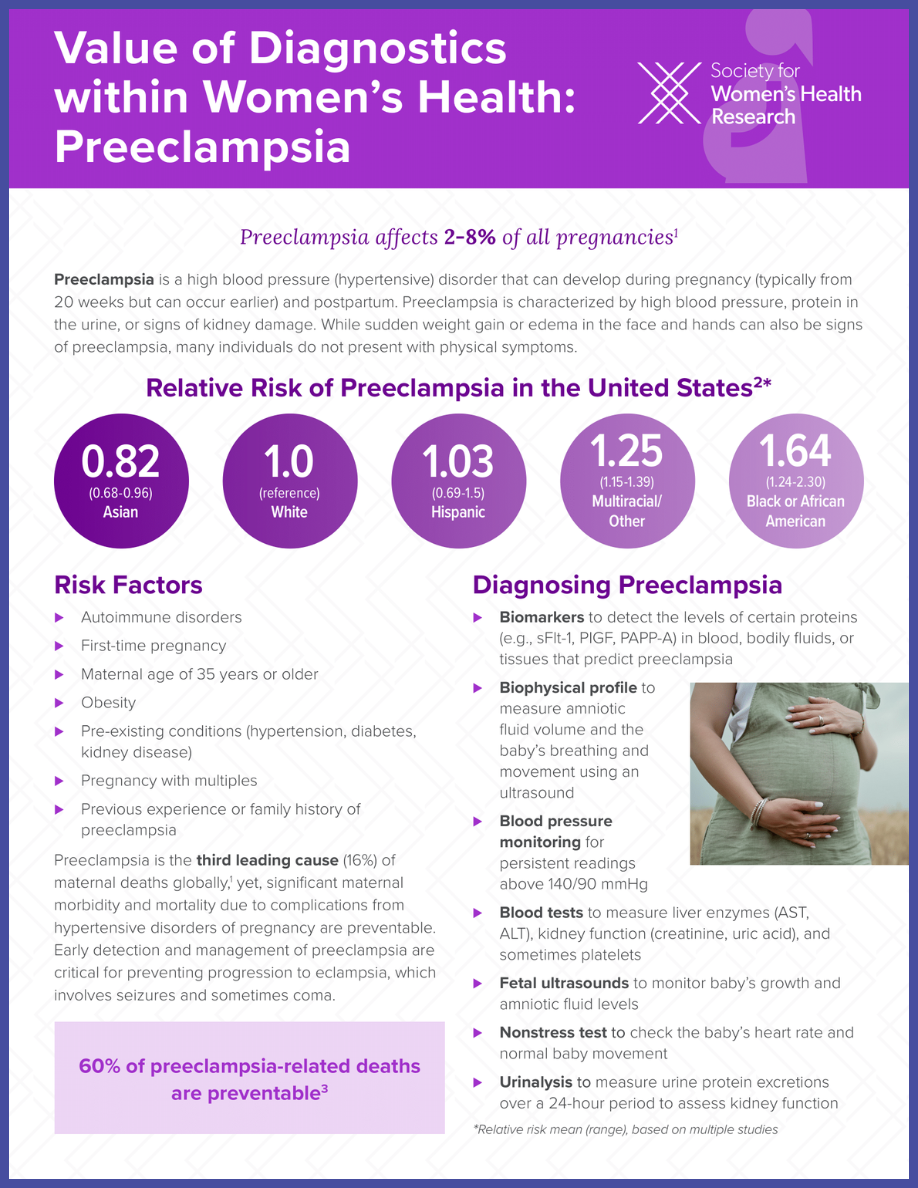
Dr. Weiner concluded his remarks by posing a striking question that underscored the urgency for further research: “How often is there an opportunity to change the lives of millions of people annually?”
Alongside the public forum, SWHR released an educational fact sheet titled “Value of Diagnostics within Women’s Health: Preeclampsia.” The resource offers a comprehensive overview of key statistics, risk factors, underlying scientific drivers, and policy histories related to preeclampsia. Designed to be clear and accessible, the fact sheet equips readers with actionable guidance on preeclampsia diagnostics, such as recommending regular blood pressure monitoring for those with preexisting risk factors.
Closing Gaps in Gestational Diabetes Diagnostics
During SWHR’s “From Screening to Solutions in Gestational Diabetes Diagnostics” forum, Maisa Feghali, MD, MS, highlighted the benefits of effective diagnostic approaches for maternal patients with gestational diabetes. She discussed the persistent gaps in diagnosis that remain for diverse patient populations and highlighted emerging approaches aimed at addressing these disparities.
Dr. Feghali stated that one in 12 pregnancies will be complicated by gestational diabetes in the United States, a number that has been increasing since 2016. Gestational diabetes is a form of diabetes that develops exclusively during pregnancy when the body cannot produce enough insulin to keep blood sugar levels within a normal range. The condition is most commonly diagnosed through fasted oral glucose testing around 24 to 28 weeks of pregnancy. This process typically begins with a one-hour glucose screening test. Then, if results are elevated, patients return for a more comprehensive three-hour oral glucose tolerance test to confirm the diagnosis. Dr. Feghali acknowledged limits of this current diagnostic approach, explaining that its length and burdensome nature can create logistical barriers for patients. Still, she emphasized that screening for gestational diabetes remains effective at reducing maternal morbidity, improving neonatal outcomes, and lowering future risk of type 2 diabetes.
“We know that there is quite a significant variation when it comes to incidence of gestational diabetes by certain patient characteristics,” said Dr. Feghali. To illustrate this point, she shared data illustrating differences in incidence by race, age, and body mass index, as well as notable urban-rural disparities. Dr. Feghali then noted the systemic lack of consideration for these disparities, noting that diagnostics and risk prediction often “do not address considerations such as neighborhood walkability and availability of ‘healthier’ food sources within a mile of individual’s homes.”
Dr. Feghali concluded by emphasizing the need to more meaningfully incorporate patient perspectives into the development of diagnostic approaches. “A lot of times testing has been very prescriptive from the point of view of data that is most meaningful for providers,” she said. “We need to think about how to avoid increasing patient burden and which diagnostics can provide a more thoughtful measurement of metabolism.”
Looking Forward
Building on three past years of the Value of Diagnostics within Women’s Health program, the 2025 program highlighted the effectiveness of diagnostics in improving maternal health outcomes specifically for mothers. Given their impact on such a large portion of pregnant people in the United States, diagnostics for gestational diabetes and preeclampsia should remain central to future medical innovations.
Explore more topics from the SWHR Value of Diagnostics within Women’s Health series, related to heart health, cancers, and more: