

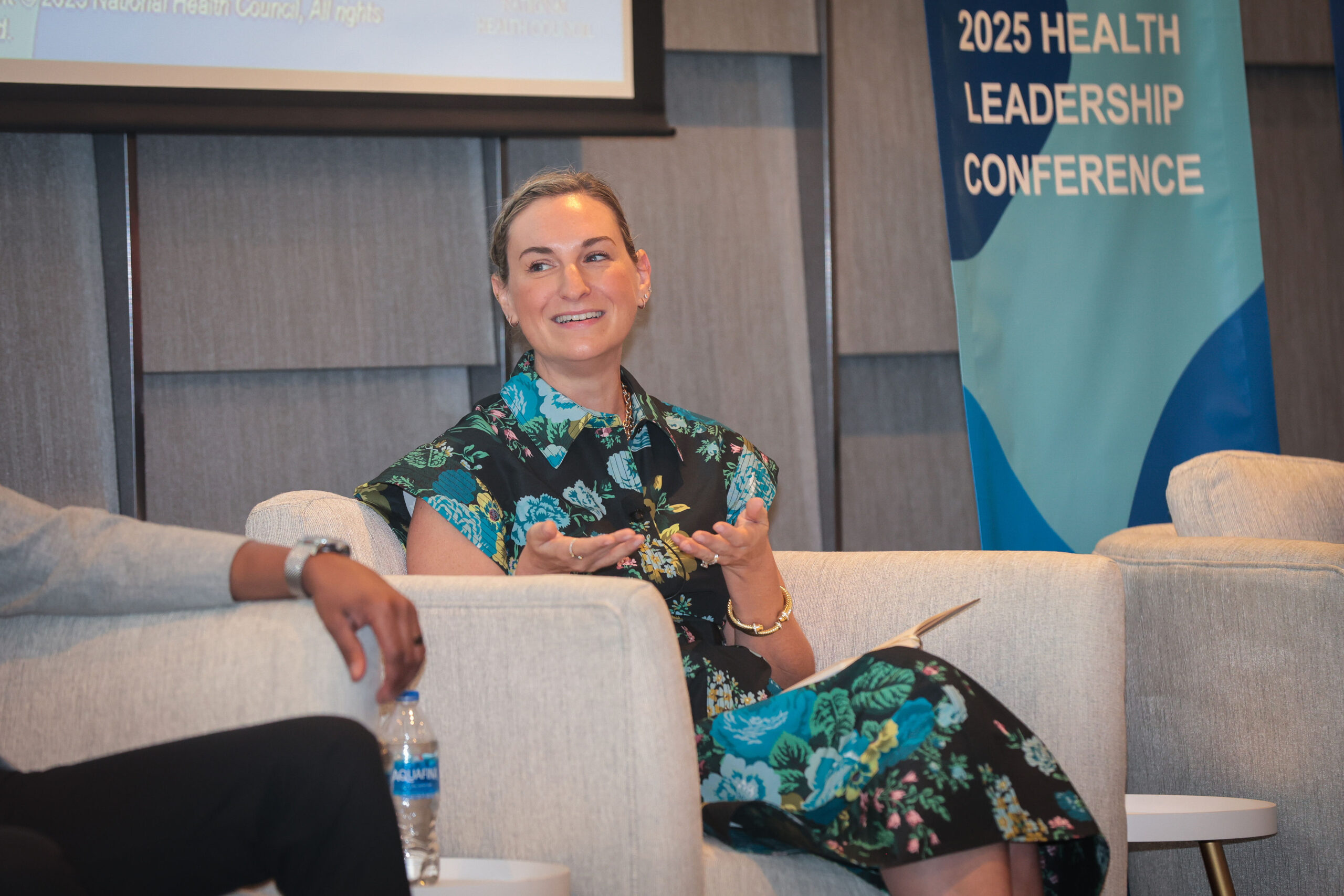
Pictured above: Kathryn Schubert speaking at the National Health Council 2025 Health Leadership Conference in spring of 2025.
By Kathryn Schubert, MPP, CAE, President and CEO of SWHR
As we quickly approach the end of 2025, I find myself reflecting on a year that has been marked by both significant challenges alongside tremendous progress that has tested our resilience and resolve as a community. Through it all, though, I’m most proud of the Society for Women’s Health Research (SWHR) team for staying focused on the mission – to advance women’s health through science, policy and education, while promoting research on sex differences to optimize women’s health. We truly are making women’s health mainstream – so much so that I’m noticing people use the word “mainstream” when talking about women’s health and research! We’re delighted so many people are talking about something that we’ve been pushing for over the last 35 years.
This year has demanded that we advocate louder, collaborate more broadly, and remain steadfast in our commitment to advancing women’s health research and policy. As I look toward 2026, I’m reminded that the work we do at SWHR—and the collective efforts of our partners, allies, and champions on Capitol Hill and beyond—has never been more critical.
The Dynamic Environment
Every federal transition—whether a new administration and/or a new Congress—presents shifting priorities, a learning curve, and a bit of unpredictability. This year proved to give us that and more. Uncertainty amongst federal agencies and new priorities created some delay in engagements, so at times it took us a little longer than usual to regain our footing during this transition year. The changes also pushed us to think more creatively when it comes to private philanthropic investment in women’s health and research as well as engaging and tracking state level progress on a variety of areas including midlife health and menopause.
Key Victories in 2025
Women’s Health Initiative (WHI) Decision Reversal
In April, the women’s health research community faced a critical threat when the U.S. Department of Health and Human Services (HHS) announced plans to terminate funding for the Women’s Health Initiative—the landmark study that has tracked the health of over 160,000 women since the 1990s and fundamentally shaped our understanding of diseases affecting women. Although certainly not perfect, we felt that canceling this important dataset would result in stalled progress and understanding of women’s healthwhen we are already so far behind. At SWHR, we immediately mobilized colleagues across the research and advocacy community, recognizing that this funding gap would result in acute losses of knowledge generation on cardiovascular disease, cancers, and osteoporotic fractures that differently or uniquely affect women. Within days, the administration reversed its decision, restoring funding to what Secretary Kennedy himself called “mission critical for women’s health.” This rapid reversal demonstrated the power of coordinated advocacy, media attention, and the undeniable value of sustained investment in women’s health research. As we continue to build momentum around women’s health—from the White House Initiative on Women’s Health Research to increased private sector investment—the WHI funding restoration reminds us that progress is never guaranteed, and our vigilance matters.
A Historic FDA Decision on Hormone Replacement Therapy
In November, the Food and Drug Administration (FDA) announced a decision that has already reverberated through women’s health and will for decades to come: the removal of black box warnings from hormone therapy products for menopause. After more than two decades of fear and misinformation surrounding hormone therapy for menopause – specifically for local, low-dose (vaginal) estrogen – the FDA initiated the removal of broad black box warnings from hormone therapy products, following a review of the latest scientific evidence. FDA Commissioner Marty Makary noted that tens of millions of women have been denied the life-changing and long-term health benefits of hormone therapy because of medical dogma rooted in a distortion of risk. While there is much more to do on this topic,- including continuing to engage in shared decision making, this announcement represents a victory and will allow millions of women access to treatment and the ability to make informed decisions about their health. SWHR will be watching very closely how the FDA and sponsors implement these changes.
Congressional Champions Step Up—Even in Crisis
The past year has also demonstrated the power of bipartisan commitment to women’s health research funding, even amid extraordinary challenges. The Senate Appropriations Committee approved its fiscal year 2026 HHS funding bill, which would provide a $400 million increase in funding to the National Institutes of Health (NIH), including a $20 million increase for the Eunice Kennedy Shriver National Institute of Child Health and Human Development (NICHD), while notably rejecting the administration’s proposal to drastically downsize HHS. The bill also includes language directing NICHD to prioritize research into gynecologic conditions, including uterine fibroids and polycystic ovary syndrome (PCOS). This is exactly the kind of targeted investment we need to close the research gaps that have plagued women’s health for far too long. Extending this bipartisan collaboration, on September 16, SWHR joined Perelel Health to host a women’s health research roundtable, which brought together key Congressional leaders, industry partners, and research advocates to chart a path forward. The conversations we had that day—about sustainable funding mechanisms, research priorities, and the urgent need to maintain momentum—laid important groundwork for future advocacy.
Weathering the Storm through the Government Shutdown
Of course, 2025 also tested us in ways we couldn’t have anticipated. The 43-day government shutdown that began October 1 and ended November 12 became the longest government shutdown in U.S. history. And the issues surrounding why the government shut down remain, even as the government reopened: the Affordable Care Act premium increases, which now loom over the end of the year. For those of us in the women’s health community, the shutdown wasn’t just an abstract political battle; it had real consequences for research, for federal employees, and for the patients and families who depend on continued scientific progress. During those 43 days, we at SWHR worked tirelessly to communicate with our partners in and outside of Congress, to amplify the voices of researchers whose work was in jeopardy, and to make clear that women’s health research cannot be treated as a bargaining chip. I personally took to Instagram and LinkedIn to share updates on the impact of the shutdown and progress on negotiations.
This year reminded us of a fundamental truth: progress in women’s health is fragile, and we must remain vigilant in protecting the infrastructure, funding, and scientific integrity that underpins it all.
Looking Ahead to 2026
As we mark the end of our 35th anniversary year and prepare to turn the page to 2026, I am reminded that our organization exists for an important reason: to make women’s health mainstream. I am energized by the foundation we’ve built over the last three decades while remaining sobered by the work that remains.
Speaking of that work, here is what we must prioritize in the coming year:
- Sustaining Research Funding: We cannot allow the momentum of the moment to dissipate. The modest increases we’ve secured are a start – between FY2003 and FY2020 the funding for the Office of Research on Women’s Health increased just $4 million from $41 million in FY2003 to $45 million in FY2020. In FY2025 the ORWH budget was $76.48 million. This is a large increase that was much needed, but the increases for ORWH are not indicative of the comprehensive need for women’s health research across the federal enterprise. And it’s nowhere near the $12 billion transformational investment that the Women’s Health Research Initiative called for. We must continue making the case that women’s health research isn’t a special interest—it’s a national imperative that affects half the population and strengthens our entire health care system and economy.
- Implementing Evidence-Based Policy: Following the data is crucial when it comes to implementing effective policy. We need more data in areas where outdated assumptions have limited women’s access to care, from the inclusion of pregnant and lactating women in clinical trials to the development of sex-specific diagnostic tools and treatments. We need new data where is hasn’t existed before, in gynecologic disease across the lifespan and sex differences in autoimmune disease, and we need science to lead the way in federal decision-making. Without data, we cannot achieve meaningful progress.
- Building Resilient Infrastructure: The government shutdown exposed the vulnerability of our research infrastructure. In 2026, we must advocate not just for funding but for policies that protect ongoing studies, preserve institutional knowledge, and ensure that women’s health research can withstand political turbulence. If we prepare now, we can build a more resilient health care future.
- Amplifying Voices: Women are not a monolith, and our research and policies must reflect the full spectrum of women’s experiences. This means prioritizing research on conditions that disproportionately affect women, ensuring clinical trials include representative populations, and addressing the social determinants of health that create disparities across populations of women. This also means centering the patient voice in everything we do – because everything we do is for patients.
A Call to Action
I often say that SWHR’s greatest strength is our ability to convene—to bring together researchers, clinicians, policymakers, industry leaders, and patient advocates around a shared vision. The events of 2025 have reinforced why this work matters and why we cannot do it alone.
As we head into 2026, I’m asking each of you to lean in: Reach out to your representatives and senators. Share your stories. Support organizations doing this critical work (if you’d like to support SWHR, you can do so here). Participate in clinical trials. Mentor the next generation of women’s health researchers. Stay informed and help educate others on why women’s health research is not a niche issue but a true cornerstone of public health.
All of us working together as a groundswell will lead to change.
Looking back at 2025, I see a year that tested us but also reminded us of our collective power. Looking ahead to 2026, I see enormous possibility—if we maintain our focus, deepen our partnerships, and refuse to accept the status quo.
At SWHR, our foundation is scientific integrity. This year reminded us that when we champion rigorous science and refuse to accept outdated paradigms, we can change the trajectory of women’s health. We can make women’s health mainstream. I can’t wait to see what we do together in 2026. The women and families counting on us deserve nothing less.