Webinars & Videos
Alzheimer’s disease is a growing public health crisis in the United States, disproportionately impacting women, who are twice as likely as men to develop the condition. Among the nearly 6 million Americans aged 65 and older living with Alzheimer’s, women account for two-thirds—making it the leading cause of death for women in this age group. With projections estimating that 13 million Americans will be living with Alzheimer’s by 2050, early detection through improved screening and diagnostics is essential to enhancing patient outcomes and easing the burden on families and caregivers. Legislative action is critical to supporting these efforts and ensuring access to comprehensive care, resources, and support for those affected.
This May, the Society for Women’s Health Research (SWHR) hosted a congressional briefing to educate members of congress and their staff on Alzheimer’s disease and its disproportionate impact on women’s health. This session offered an overview of the current state of Alzheimer’s disease screening and diagnostics, including potential policy opportunities to close existing gaps, as well as other legislative pathways to address barriers in Alzheimer’s treatment, care, and long-term support for patients and caregivers.
The event featured a moderated discussion with leading experts who shared insights into the latest research, ongoing challenges, and actionable policy solutions aimed at improving outcomes for those affected by Alzheimer’s disease—with a particular focus on women.
The SWHR Breaking Barriers in Alzheimer’s Disease series includes:
View the original event page here: Early Signs, Lasting Impact: Policy Pathways in Alzheimer’s Disease Detection and Care
Julie Dumas, PhD is a Professor and Vice Chair for Faculty in the Department of Psychiatry at the University of Vermont. She received her PhD in cognitive psychology from the University of North Carolina at Chapel Hill and completed her post-doctoral fellowship in clinical neuroscience at the University of Vermont. Her research focuses on the cognitive neuroscience of menopause, normal aging, and Alzheimer’s disease. Specifically, she examines how the aging of hormone and neurotransmitter systems influences cognition in women. She also examines how biomarkers for Alzheimer’s disease that appear in midlife influence cognition and risk for pathological brain aging.
Jennifer Pollack, JD, brings over 12 years of legislative and political experience to her position as Director, Access Policy for the Alzheimer’s Association and Alzheimer’s Impact Movement (AIM). In this capacity, she works to develop federal policies on access for AIM and the Association furthering the goal of access to treatment, diagnostics and care for people living with dementia. Additionally, she’s worked with members of Congress to move the key AIM federal legislative priorities including the Comprehensive Care for Alzheimer’s Act and the Equity in Neuroscience and Alzheimer’s Clinical Trials (ENACT) Act. Before joining the Association, Jennifer worked at a trade association advocating on behalf of medical group practices. Previously, Jennifer served as a Legislative Assistant in the House of Representatives for two different members of Congress. She has a BA from The George Washington University and a JD from the Catholic University of America, Columbus School of Law.
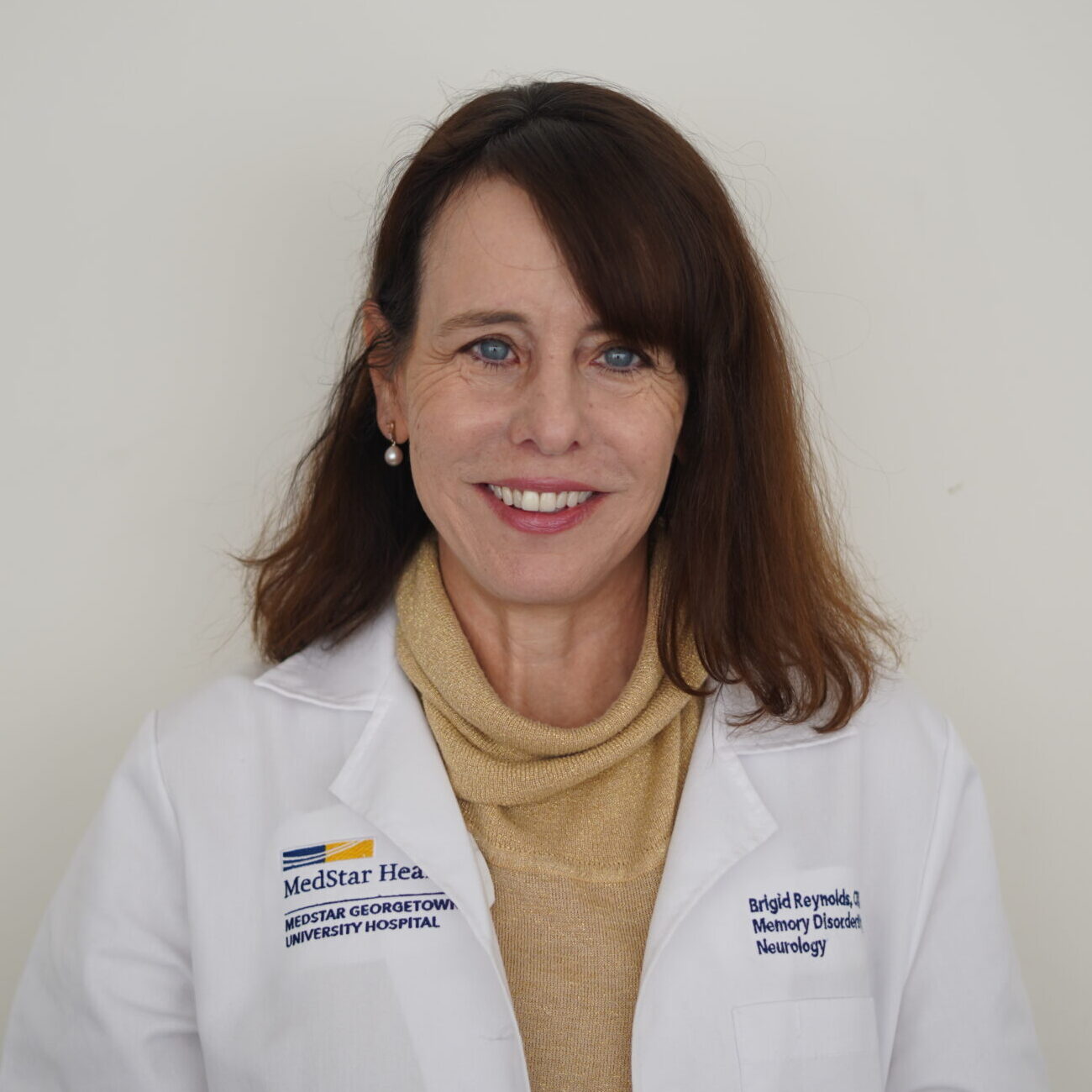
Brigid Reynolds is a Nurse Practitioner and Faculty Member at Georgetown University, specializing in clinical trial research and the evaluation and treatment of Alzheimer’s disease and related disorders. Since joining the Memory Disorders Program in 2001, she has been a leader in both clinical care and research for patients living with dementia. Her current research interests focus on developing new treatments for behavioral symptoms associated with dementia. She serves as Co-Principal Investigator of the LiBBY study, a multi-center, NIA-funded clinical trial investigating a THC-CBD oral combination for the treatment of agitation in hospice-eligible participants with dementia.
Brigid earned her MS in Nursing from the Catholic University of America and her BS in Nursing from Emory University. She is certified by the American Nurses Credentialing Center. Before joining the Memory Disorders Program, her career included extensive experience in home care, primary care, and case management for older adults.
Diane Ty is the Managing Director of the Milken Institute Future of Aging, where she leads efforts to advance healthy longevity and financial security for all, through a life course approach to aging. Under her leadership, the program drives research, convenings, multisector partnerships, and the promotion of high-impact policies and practices. She also oversees the Alliance to Improve Dementia Care, a signature initiative uniting more than 130 organizations and thought leaders to transform the complex health and long-term care systems that serve people living with or at risk for dementia, along with their caregivers.
Ty serves as a senior advisor at Georgetown University’s Business for Impact at the McDonough School of Business, where she previously led consulting engagements in health and financial security and founded initiatives such as the AgingWell Hub and the Portion Balance Coalition. Her career spans executive roles at AARP, AARP Services, Inc., Save the Children, and American Express, as well as strategic consulting for nonprofits and startups.
She earned her undergraduate degree from Duke University and was a Lauder Institute Fellow at the University of Pennsylvania, earning both an MBA from the Wharton School and an MA from the School of Arts and Sciences. Ty is active in public service, serving on the board of Capital Caring Health and as a gubernatorial appointee to the Maryland State Commission on Aging.

Support for this educational program has been provided by Eli Lilly and Roche. SWHR maintains independence and editorial control over program development, content, and work products.