

By Madelyn Adams, MPA, SWHR Public Policy and Advocacy Manager and Lindsey Miltenberger, MA, SWHR Chief Advocacy Officer
Obesity has emerged as a pressing public health challenge, with rising prevalence rates posing serious implications for individual well-being. While the issue is increasingly drawing attention from public health experts and policymakers, there is still limited awareness of how obesity uniquely affects women and how best to manage the disease and related comorbidities.
Across 101 countries, women have a higher prevalence rate of obesity than men in 87% of them. Additionally, women have higher rates of severe obesity than men in the United States. This global pattern, consistent across diverse cultures and diets, suggests that biological factors play a significant role in the disease. Yet research has barely scratched the surface of what this means for women’s health and how best to diagnose, treat, and prevent obesity in women.
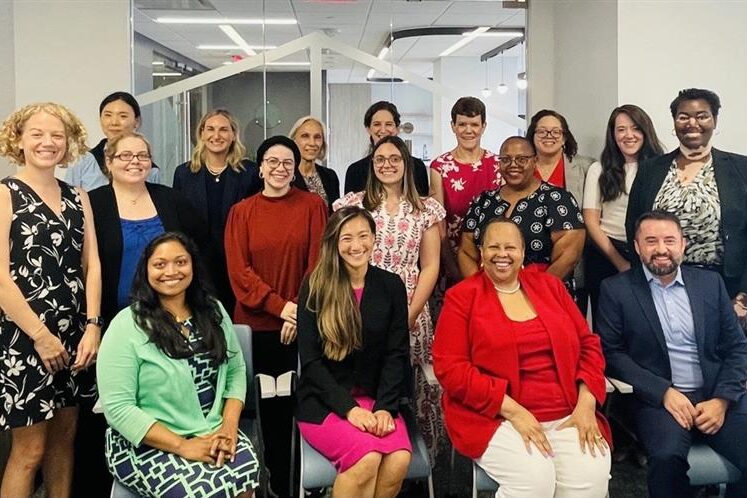
This important framing is how Karen Reue, PhD, professor at the University of California, Los Angeles, kicked off the Society for Women’s Health Research (SWHR) roundtable convening, “Navigating the Biological and Health Care Complexities of Obesity in Women,” which took place in Washington, D.C. on July 21-22. The roundtable brought together interdisciplinary experts to discuss sex differences in obesity, comorbidities for women living with obesity, and strategies for more effective and equitable interventions.
Understanding Biological and Clinical Complexities
Fat metabolism and body composition in women is unique, Dr. Reue shared in her presentation. Starting in adolescence, girls develop more fat mass than boys, and body composition shifts across women’s lifespans. These changes are regulated not just by hormones like estrogen and testosterone, but by sex-specific genetic activity in adipose tissue, blood vessels, and even the nervous system.
Despite this, research often fails to account for these differences—frequently using male animal models, underrepresenting women (especially women of color) in clinical trials, or not disaggregating research data by sex. This de-emphasis on sex differences can skew understanding of disease presentation and progression, leading to gaps in how treatment responses are studied and applied in a clinical setting. As a result, women may receive therapies that are less effective or come with unanticipated side effects, particularly in metabolic conditions where sex-specific biology plays a central role. More research is needed into sex differences in adipose tissue, a type of tissue that stores energy in the form of fat, across the lifespan and response to treatments like GLP-1s. For example, fluctuations in estrogen and progesterone throughout the menstrual cycle may influence fat distribution, energy metabolism, and insulin sensitivity, yet few studies focused on obesity research these cyclical changes. Ignoring these patterns may limit the accuracy of clinical findings and therapeutic interventions tailored for women.
In addition to research gaps, some of the more commonly used tools for diagnosing obesity – such as body mass index (BMI) – are inadequate for evaluating nuances of body composition. Roundtable participants discussed alternative tools for diagnosis obesity including measuring waist circumference. Further, a lack of clear diagnostic criteria is a barrier to accurately and efficiently diagnosis obesity in women. Roundtable participants also raised how diagnosing obesity may be further complicated by the presence of comorbidities. Women with obesity are at risk of obesity-related comorbidities like cardiovascular disease (CVD) and type 2 diabetes, and yet these overlapping health risks are rarely treated in an integrated way, leading to fragmented care. Obesity is associated with over 230 medical complications, many of which may persist even after weight loss, underscoring the need for improved diagnostics as well as comprehensive and individualized treatment approaches.
The Complexities of Stigma and Structural Barriers to Care
During roundtable conversations, speakers shed light on an often-overlooked issue: the impact of weight bias and stigma on women living with obesity.
Obesity is a complex, chronic condition, yet misconceptions about the condition persist. Ariana M. Chao, PhD, CRNP, FNP-BC, RN, professor at Johns Hopkins University, noted during her presentation that a staggering 85% of people with obesity believed that managing obesity was solely their individual responsibility and nearly half view it simply as a result of poor lifestyle choices, like diet or exercise habits. Dr. Chao also noted that people wait, on average, nine years from the time they begin struggling with their weight to when they finally speak to a health care provider. Other studies detailed that women report discrimination at lower body weights than men, and for women with obesity, discrimination can result lower wages, biased medical treatment, and internalized stigma that undermines mental and physical health.
Participants noted that this data reflects a culture that shames rather than supports women with obesity. Too often, interventions focus solely on individual behavior change, and society often places blame on individuals living with obesity as a lack of willpower of discipline. Providers may focus solely on a “calories-in, calories-out” treatment approach, rather than exploring the complex contributors to obesity including biological, environmental, and hormonal factors.
In addition to biological and hormonal factors, sociocultural influences (such as housing instability, food insecurity, lack of safe physical spaces, and discrimination) can have a bearing on weight management efforts. In addition to these barriers, women are also burdened by biases rooted in gender norms. For example, one roundtable participant noted how mothers of children with obesity may face additional layers of bias and judgement rooted in notions around motherhood. Society often assumes that a mother is solely responsible for her child’s nutrition and weight, placing blame squarely on her shoulders when a child struggles with weight. This kind of judgment not only reinforces stigma but also discourages families from seeking support.
These issues are embedded in cultural norms and structural barriers. Broader progress is needed to tackle upstream issues associated with social determinants of health—from expanding access to healthy food pharmacies and delivery programs, to recognizing obesity as a disease requiring chronic treatment — not just temporary fixes.
“I think there’s been some progress in recent years of more recognition that we need to be thinking about more policy interventions that go beyond obesity-specific policies,” said Rebecca Pearl, PhD, Associate Professor at the University of Florida. “Of course, nutrition and activity are important policies to consider, but we need to be thinking about transportation, housing, childcare, and maternity leave. These are all factors that are going to affect obesity.”
In addition to structural solutions, clinical providers also have a role to play in reducing stigma. When it comes to addressing obesity in women, applying a more nuanced, patient-centered approach within the U.S. health care system is essential to improving outcomes. While policy conversations often center around insurance coverage, true access to care goes far beyond simply having access to health insurance; it includes timely access to accurate diagnoses, respectful clinical environments, and treatment plans that are tailored to the individual. One roundtable participant put it plainly: “All my health care is obesity care, because I have obesity,” said Sarah Bramblette, MSHL Senior Advocacy Manager with the Obesity Action Coalition. This sentiment reflects a common challenge: once a person carries an obesity diagnosis, there can be a tendency among providers to dismiss health concerns and attribute all such concerns to weight. Oversimplifying care through the lens of weight not only risks misdiagnosis but also delays appropriate treatment. Patient experience must be at the center of care. To ensure that patients are receiving the care most appropriate for them, medical providers should prioritize shared decision-making and acknowledge the full scope of health beyond weight.
Policy Gaps and Opportunities
Despite obesity being a chronic disease, federal policies fail to treat it as such, often leaving individuals without access to the full range of treatment options. Over the course of the roundtable, participants highlighted several barriers to access and care for individuals living with obesity.
Notably, many individuals living with obesity are subject to step therapy, an insurance policy requiring individuals to try and “fail” lower-cost medications before they can access the medication initially prescribed by their provider. For many patients, step therapy requires extra time and money for medications that may not be the most clinically appropriate, delaying access to more effective medications preferred and prescribed by the provider. Additionally, without a true understanding of the chronicity of obesity, access to treatments and insurance coverage may incorrectly change when a patient’s weight or BMI improves. Obesity is a multi-factorial disease and treating it with a uniform approach ignores disease complexity and interferes with a doctor’s clinical judgment to tailor treatment to the patient.
Additionally, treatment coverage is lacking for comprehensive obesity treatments, such as GLP-1 medications or intensive behavioral therapy (IBT). For example, the Affordable Care Act mandates screening, but does not require treatment coverage for obesity. For those receiving food benefits through the Supplemental Nutrition Assistance Program (SNAP), participants noted that hot meals aren’t covered. Some legislative solutions, such as the Treat and Reduce Obesity Act (TROA), have been introduced to improve access to tools for the prevention and treatment of obesity, but they are being debated in a difficult political and fiscal environment.
Policy solutions must address both biology and the environment. Some pathways discussed included:
- Standardizing obesity screening treatment and coverage
- Training providers to treat obesity as a chronic condition, integrating it into all specialties, such as cardiology, endocrinology, and psychiatry
- Funding inclusive research that reflects racial, ethnic, gender, and socioeconomic diversity
- Embedding patient-reported outcomes into treatment models, focusing not just on weight loss but on lived experience, side effects, and quality of life
- Utilizing group models for health care visits, which could be a time-saving measure and provide social support for individuals
- Using telehealth across all areas of clinical expertise
A Path Forward
An overarching theme of the two-day roundtable was that the conversation around obesity needs to shift toward a science-based, compassionate, and equitable approach to care. The prevalence of obesity in U.S. adults is 40.3%, and recent projections published in The Lancet suggest that by 2050 one in three adolescents and two in three adults will have obesity. Women face unique biological, hormonal, and sociocultural influences that shape their risk for weight gain and can have a bearing on weight management efforts. Beyond the health risks imposed by obesity, women with obesity experience additional barriers to care due to stigma, economic inequality, and limited access to appropriate care. Centering comprehensive solutions to these issues in the national approach to obesity care and policy could help improve outcomes for women across the lifespan.